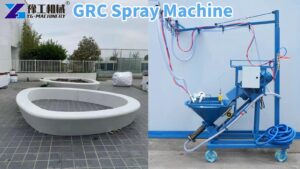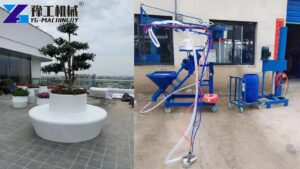
Singapore continues to expand its use of prefabricated construction methods and architectural concrete components. Glass Fiber Reinforced Concrete (GRC) has become an important material for curtain walls, façade panels, decorative elements, and lightweight precast products because it combines low weight with high strength and excellent design flexibility. In early 2025, a Singapore-based architectural products manufacturer contacted YG Machinery after searching for a reliable GRC production line capable of supporting higher production efficiency while maintaining consistent product quality.
The customer had previously relied on semi-manual production equipment. Although the existing process produced acceptable products, increasing project demand exposed several production bottlenecks. After several rounds of technical discussions, factory evaluations, and equipment demonstrations, the customer selected a customized GRC spray production solution supplied by YG Machinery.
This project documents the entire process, from the first inquiry to successful production in Singapore, providing practical reference for companies planning to invest in modern GRC manufacturing equipment.
Start Your Project with the Right Equipment
The First Inquiry About A GRC Production Line
The first email arrived through the YG Machinery website. The customer introduced itself as a manufacturer producing architectural façade panels, decorative cornices, window surrounds, and customized GFRC components for commercial buildings across Singapore.
Their production volume had increased steadily during the previous two years. Several ongoing projects required larger monthly output while maintaining strict dimensional tolerances. Existing equipment required extensive manual operation, making production scheduling increasingly difficult.
The purchasing manager listed several priorities.
- Stable spraying performance
- Uniform glass fiber distribution
- Higher daily production capacity
- Easy maintenance
- Compact factory layout
- Reliable technical support
- Long-term spare parts availability
Instead of requesting a quotation immediately, the customer asked detailed questions about spraying technology, fiber feeding systems, pump stability, and expected production efficiency.
Because the inquiry contained detailed technical information rather than simple pricing questions, our engineers recognized that the customer had already compared several suppliers before contacting YG Machinery.
Understanding The Customer’s Production Requirements
Rather than recommending equipment immediately, YG Machinery arranged an online technical meeting involving engineers from both companies.
During the meeting, the customer explained the complete manufacturing process currently used inside their factory. Engineers reviewed workshop dimensions, existing mixing equipment, mold sizes, labor allocation, daily production targets, and future expansion plans.
Several production challenges became obvious.
Manual spraying produced inconsistent fiber distribution across large façade panels. Material utilization fluctuated between production batches. Product thickness varied depending on operator experience. Production efficiency also declined whenever experienced technicians were unavailable.
The engineering team calculated projected capacity according to planned monthly output and recommended upgrading to an integrated GRC production line instead of replacing individual machines.
The proposed solution would improve production consistency while allowing the customer to expand manufacturing capacity without significantly increasing labor requirements.
Both engineering teams agreed that equipment reliability and long-term production stability would be more valuable than simply selecting the lowest purchase price.
Boost Productivity—Get a Free Quote
Why The Customer Compared GRC Spray Machine Price Before Making A Decision
Before selecting a supplier, the customer compared several international manufacturers.
During discussions, GRC spray machine price remained an important consideration. However, the purchasing manager explained that initial investment represented only one portion of the total operating cost.
The customer evaluated several additional factors.
- Production efficiency
- Fiber distribution quality
- Equipment reliability
- Maintenance requirements
- Spare parts availability
- Technical documentation
- Operator training
- After-sales support
YG Machinery prepared a detailed comparison showing estimated production costs over several years rather than focusing only on equipment pricing.
Engineers also demonstrated previous export projects involving architectural GRC production, allowing the customer to evaluate equipment performance under real manufacturing conditions instead of relying only on catalogue specifications.
Following several video conferences, factory videos, and technical discussions, the customer confirmed that the proposed configuration best matched current production requirements while providing sufficient capacity for future business expansion.
In the next section, we will cover:
- Customized Solution From A GRC Machine Manufacturer
- Technical Parameter Table
- Video Factory Inspection
- Order Confirmation And Production Arrangement
Customized Solution From A GRC Machine Manufacturer
After confirming the customer’s production objectives, YG Machinery prepared a customized equipment proposal instead of offering a standard configuration. The engineering team focused on matching production capacity with factory layout, manpower allocation, and the dimensions of the customer’s architectural products.
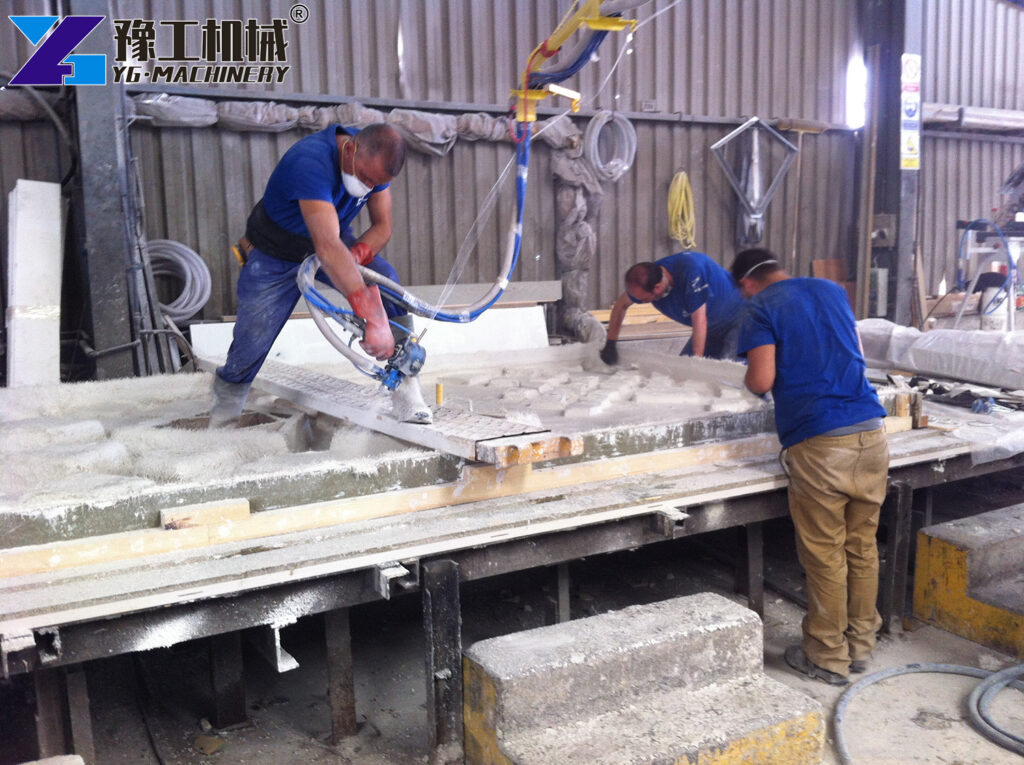
Because the factory mainly produced façade panels, decorative cladding, columns, and customized architectural ornaments, the spraying system needed to maintain stable glass fiber distribution while allowing operators to switch efficiently between different molds.
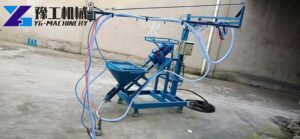
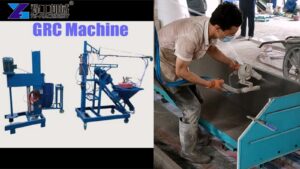
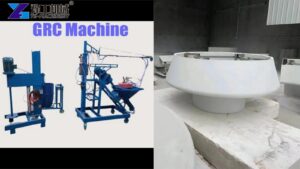
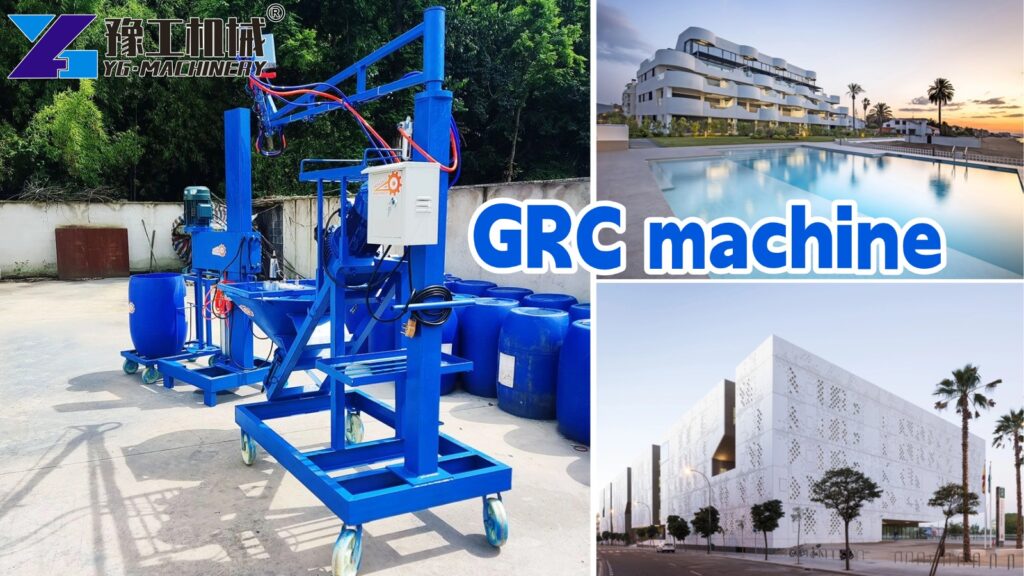
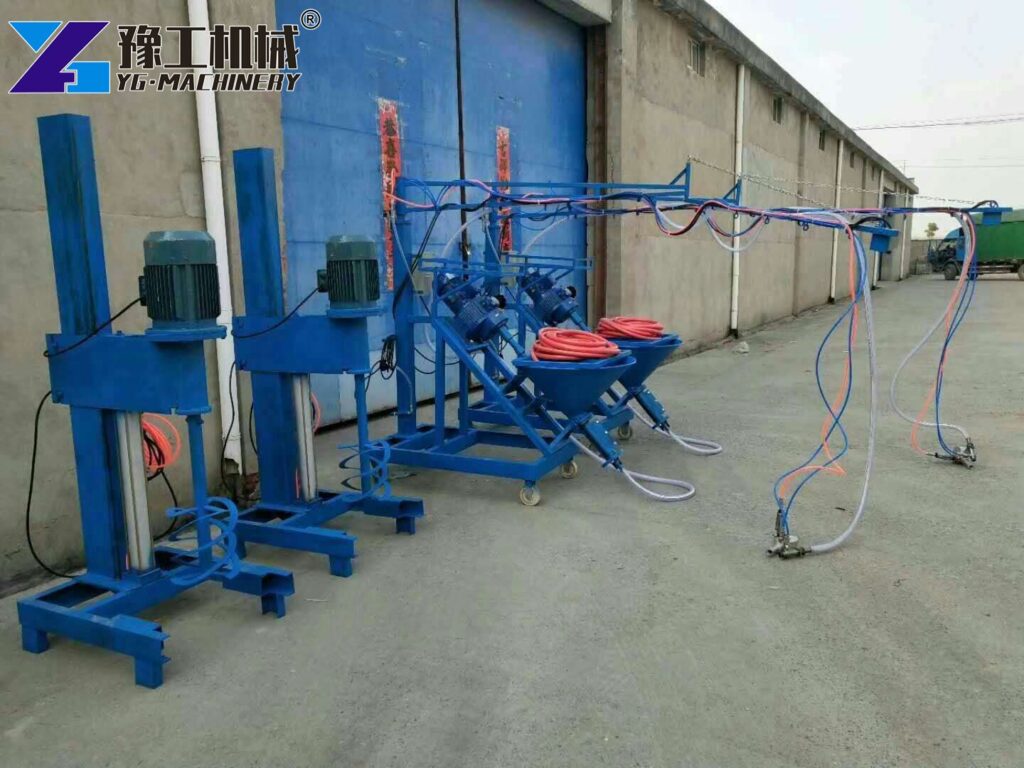
As an experienced GRC machine manufacturer, YG Machinery recommended an integrated production solution consisting of a high-efficiency spraying system, mixing unit, fiber feeding device, and hydraulic conveying system.
The recommended configuration provided several practical advantages.
- Stable spraying pressure
- Uniform glass fiber dispersion
- Continuous material delivery
- Simple operator controls
- Convenient cleaning after production
- Lower maintenance workload
- Flexible application for different mold sizes
Unlike conventional manual production, the integrated spraying system reduced interruptions caused by inconsistent material feeding and operator adjustments. This allowed production teams to maintain more stable manufacturing quality throughout long working shifts.
The customer particularly appreciated the modular equipment layout. Individual components could be serviced independently without affecting the entire production line. This reduced maintenance downtime and simplified future factory expansion.
Find the Right Model for Your Project
Automatic GRC Spray Machine Improved Production Planning
During the technical presentation, YG Machinery engineers demonstrated how the automatic GRC spray machine could improve workflow efficiency compared with the customer’s previous manufacturing process.
Instead of manually controlling fiber addition during spraying, the integrated system automatically synchronized mortar delivery with glass fiber feeding. This helped maintain more consistent reinforcement distribution throughout every production cycle.
Engineers also explained several operational improvements.
- Reduced material waste
- More stable spraying thickness
- Better surface finish
- Faster mold turnover
- Lower operator fatigue
- Improved repeatability
The customer planned to manufacture products with different thicknesses throughout the year. Adjustable spraying speed and delivery capacity therefore became important selection factors.
Because the proposed equipment supported multiple production requirements without complicated mechanical adjustments, operators could switch between product types more efficiently.
Following the demonstration, both engineering teams reviewed expected production output according to planned monthly manufacturing schedules. Capacity calculations confirmed that the selected configuration would comfortably support projected business growth during the coming years.
Technical Specifications Of The GRC Production Line
Before production began, YG Machinery issued a complete technical specification sheet for customer approval. Every major parameter was reviewed during the final online meeting to ensure compatibility with the customer’s factory conditions.
Technical Parameters
| Parameter | Specification |
|---|---|
| Product Name | Glass Fiber Reinforced Concrete GRC Spray Machine |
| Power | 2.2–4.0 kW |
| Voltage | 380 V, 50 Hz |
| Spraying Speed | 20–200 r/min |
| Maximum Workspace | 4.5 m |
| Material Delivery Capacity | 300–1600 kg/h |
| Production Efficiency | 200–400 m²/h |
| Material Tank Volume | 60 L |
| Sprayer Dimensions | 2000 × 1050 × 1600 mm |
| Mixer Dimensions | 1550 × 1000 × 2100 mm |
| Total Machine Weight | 800 kg |
These specifications matched the customer’s planned production scale while allowing sufficient flexibility for future architectural projects.
The engineering team also confirmed that the equipment could be integrated into the customer’s existing workshop without requiring major modifications to electrical supply or factory layout.
Factory Inspection Before Order Confirmation
Before making the final purchasing decision, the Singapore customer requested a remote factory inspection.
YG Machinery arranged a live video conference inside the production workshop. During the meeting, engineers demonstrated equipment assembly, spraying tests, mixer operation, hydraulic conveying, and fiber feeding under actual production conditions.
The customer carefully observed several important operating details.
- Mortar mixing consistency
- Fiber feeding synchronization
- Spraying pressure stability
- Cleaning procedures
- Control panel operation
- Routine maintenance points
Additional production videos from previous export projects were also provided. These recordings showed continuous manufacturing rather than short demonstration clips, allowing the customer to evaluate long-term operating stability.
The customer asked several technical questions regarding spare parts replacement intervals, hydraulic pump maintenance, and recommended cleaning procedures after daily production.
YG Machinery engineers answered each question in detail and provided corresponding maintenance documentation.
The comprehensive technical discussion gave the customer sufficient confidence to proceed with the purchase.
Order Confirmation And Production Arrangement
After completing the technical evaluation, both companies finalized the equipment configuration and commercial documents.
Once the advance payment was received, YG Machinery immediately scheduled production according to the agreed delivery timetable.
The manufacturing department prepared raw materials, hydraulic components, spraying systems, electrical assemblies, and control units before beginning final assembly.
Throughout production, quality inspectors monitored every manufacturing stage to ensure that critical components complied with factory quality standards.
Each major assembly would later undergo comprehensive operational testing before export, ensuring reliable performance upon arrival in Singapore.
Manufacturing, Quality Inspection, And Export Preparation
Production officially began after the engineering department released the approved manufacturing drawings. Every major component entered assembly according to the customer’s confirmed configuration. Throughout the process, quality inspectors verified machining accuracy before components moved to the next production stage.
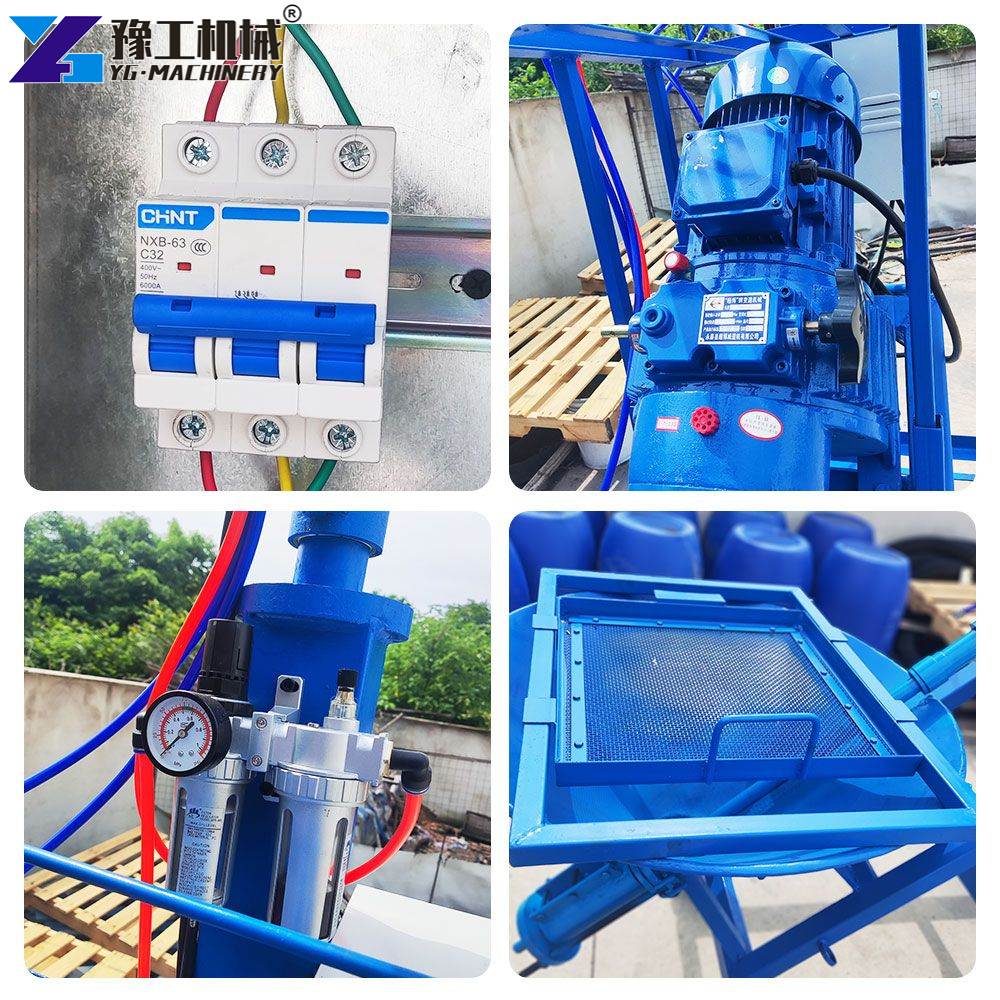
The spraying system, hydraulic pumps, material delivery pipelines, fiber feeding mechanism, mixer, and electrical control cabinet were inspected separately before final integration. Engineers also checked welding quality, electrical connections, hydraulic sealing, and alignment tolerances to reduce potential issues during long-term operation.
Before shipment, the complete production line entered the factory testing area.
The inspection program included:
- Continuous spraying performance testing
- Material delivery capacity verification
- Glass fiber feeding synchronization
- Hydraulic pressure testing
- Electrical system inspection
- Control panel function testing
- Emergency stop verification
- Continuous operation simulation
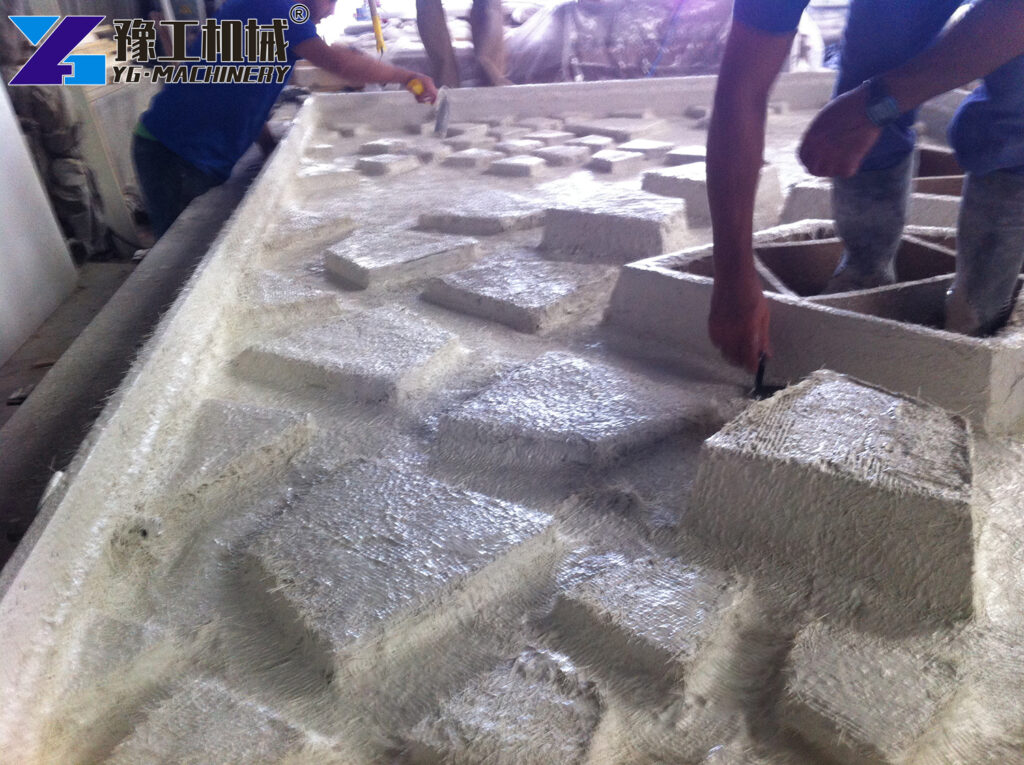
The customer attended the factory acceptance inspection through a scheduled video conference. During the live demonstration, engineers produced several GRC test panels using the completed equipment. The spraying process, fiber distribution, and finished panel quality were shown in real time.
Production data collected during testing closely matched the agreed technical specifications. After reviewing the demonstration videos and inspection reports, the customer approved the equipment for shipment.
Before loading, technicians protected hydraulic connectors, electrical components, and precision control devices with moisture-resistant packaging. Exposed steel surfaces received anti-corrosion treatment suitable for international sea transportation.
Export Packing And Ocean Shipping To Singapore
Once final inspection was completed, the export department arranged container loading according to the approved packing plan.
Because the production line consisted of multiple assemblies, each component was packed individually while maintaining a logical unloading sequence. This arrangement allowed the customer’s installation team to identify equipment quickly after arrival.
Protective measures included:
- Anti-rust coating on exposed steel
- Waterproof protective wrapping
- Reinforced wooden supports
- Shock-resistant fixing brackets
- Moisture protection for electrical cabinets
- Individual labeling of all accessories
Every package corresponded with the packing list, reducing customs inspection time after arrival.
The shipment departed from China according to the agreed delivery schedule. Throughout transportation, YG Machinery regularly updated the customer with shipping progress, container tracking information, and estimated arrival dates.
Several weeks later, the equipment arrived at the Port of Singapore without damage. Customs clearance proceeded smoothly because all export documentation had been prepared before shipment.
The customer’s logistics team transported the equipment directly to the manufacturing facility, where installation work began shortly afterward.
Installation And Operator Training
Before commissioning started, engineers inspected every major component to confirm that transportation had not affected equipment performance.
The installation process followed a predefined sequence.
First, technicians positioned the mixer and spraying system according to the factory layout. Hydraulic pipelines and electrical connections were then completed before testing individual operating functions.
YG Machinery engineers provided online commissioning support throughout the installation process.
Commissioning included:
- Hydraulic system adjustment
- Mixer calibration
- Fiber feeding synchronization
- Spraying pressure adjustment
- Material delivery testing
- Control system inspection
- Safety protection verification
Operator training focused on practical production rather than theoretical instruction.
Workers learned how to:
- Prepare raw materials correctly
- Adjust spraying parameters
- Control fiber feeding
- Clean equipment after production
- Perform daily inspections
- Replace common wear parts
- Conduct preventive maintenance
Because the control system was designed with straightforward operating logic, production staff became familiar with daily operation after only several days of training.
Following commissioning, the production line entered trial manufacturing before beginning normal commercial production.
Stable Production Performance After Commissioning
The first production batch consisted of architectural façade panels for a commercial building project in Singapore.
During initial production, engineers monitored material consistency, fiber distribution, spraying thickness, and dimensional accuracy across multiple product sizes.
The integrated production line quickly demonstrated several operational improvements compared with the customer’s previous manufacturing process.
The factory reported measurable benefits.
- Higher daily production output
- More consistent panel thickness
- Better fiber distribution
- Reduced material waste
- Faster mold turnover
- Improved production planning
Factory supervisors also observed that production scheduling became more predictable because equipment performance remained stable throughout long operating shifts.
Maintenance requirements proved relatively simple. Daily servicing mainly involved cleaning, lubrication, and routine inspection of hydraulic components. This reduced unexpected downtime and improved equipment availability.
After several months of operation, the customer confirmed that the production line had become one of the most frequently used systems inside the factory, supporting both ongoing projects and newly awarded architectural contracts.
Customer Feedback After Six Months Of Production
Approximately six months after commissioning, YG Machinery conducted a scheduled follow-up with the customer’s management team to evaluate long-term equipment performance and production results.
The Production Manager summarized the overall experience:
“The production line operates consistently every day. Product quality has become much more stable. We spend less time adjusting equipment between batches.”
The Workshop Supervisor highlighted improvements in manufacturing efficiency:
“The spraying system is easy to control. Fiber distribution is much more uniform than before. New operators also learned the process quickly.”
The maintenance department reported that routine servicing remained straightforward throughout the first several months of operation. Most maintenance work involved daily cleaning, lubrication, hydraulic oil inspection, and scheduled replacement of normal wear parts. No major hydraulic or electrical failures interrupted production during the evaluation period.
The customer also compared production records before and after installing the new equipment.
Several measurable improvements were observed:
- Daily production capacity increased significantly.
- Material utilization improved noticeably.
- Product rejection rates declined.
- Mold turnover became faster.
- Equipment downtime remained low.
- Labor efficiency improved across multiple production shifts.
Management concluded that the investment supported both current production requirements and future expansion plans. The successful project also encouraged the company to evaluate additional automated equipment for future factory upgrades.
Why More Manufacturers Choose YG Machinery
Selecting a GRC machine involves much more than comparing equipment prices. Long-term productivity depends on equipment reliability, engineering support, manufacturing quality, and after-sales service.
YG Machinery works closely with customers before production begins. Every recommendation is based on actual project requirements rather than standard configurations.
Our engineering team evaluates:
- Factory layout
- Product dimensions
- Daily production targets
- Material characteristics
- Labor allocation
- Future expansion plans
- Local power supply
- Maintenance requirements
Each machine undergoes comprehensive factory testing before shipment, including spraying performance, hydraulic inspection, electrical testing, fiber feeding synchronization, and continuous operation simulation.
Customers also receive:
- Installation guidance
- Operator training
- Maintenance manuals
- Spare parts documentation
- Online technical support
- Long-term after-sales assistance
This engineering-based approach helps customers reduce operational risks while improving production efficiency from the first day of operation.
Request A Quote For Your GRC Production Line
Every GRC factory has different production goals. Equipment should match product dimensions, production capacity, factory layout, and future expansion plans.
YG Machinery supplies complete GRC production solutions for architectural panels, decorative components, curtain walls, façade systems, landscape products, and customized GFRC manufacturing.
Our engineers can recommend the most suitable equipment according to your production requirements.
Contact YG Machinery today to receive:
- Professional equipment recommendations
- Customized production solutions
- Technical specifications
- Factory testing videos
- Competitive factory quotations
- Complete after-sales support
Whether you are upgrading an existing workshop or building a new production facility, our team is ready to help you improve manufacturing efficiency.
Frequently Asked Questions About YG GRC Production Line
The equipment is suitable for architectural façade panels, decorative moldings, cornices, columns, wall panels, window surrounds, landscape products, and customized GFRC components.
Depending on product size and spraying process, material delivery capacity reaches 300–1600 kg/h, with production efficiency of 200–400 m²/h.
Yes. YG Machinery provides online installation guidance, commissioning assistance, operation training, and maintenance support.
Yes. Spraying systems, mixers, fiber feeding devices, and control systems can be configured according to production requirements.
The standard configuration operates at 380 V, 50 Hz. Other electrical standards can be customized for different countries.
Routine maintenance mainly includes equipment cleaning, lubrication, hydraulic oil inspection, and scheduled replacement of normal wear parts according to operating hours.
Please provide your product dimensions, daily output target, factory layout, local power supply, and production process. Our engineers will recommend the most suitable configuration.