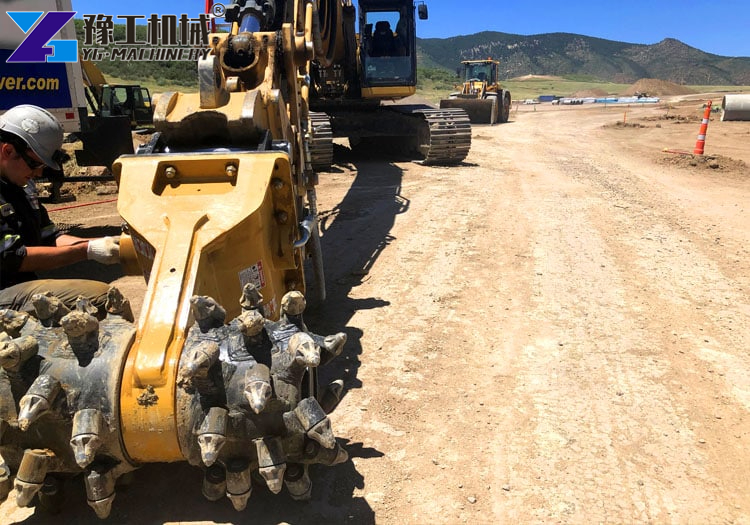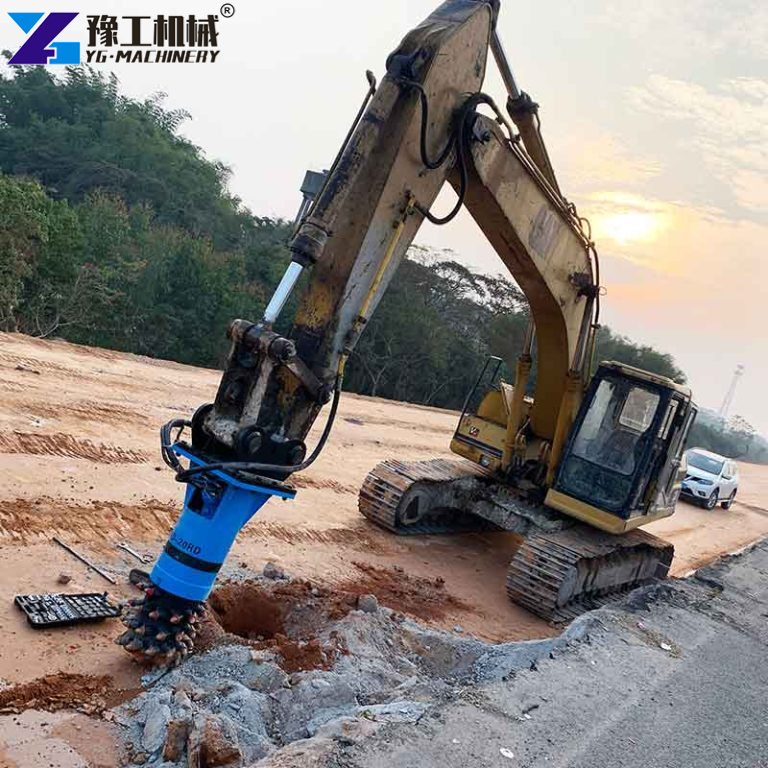
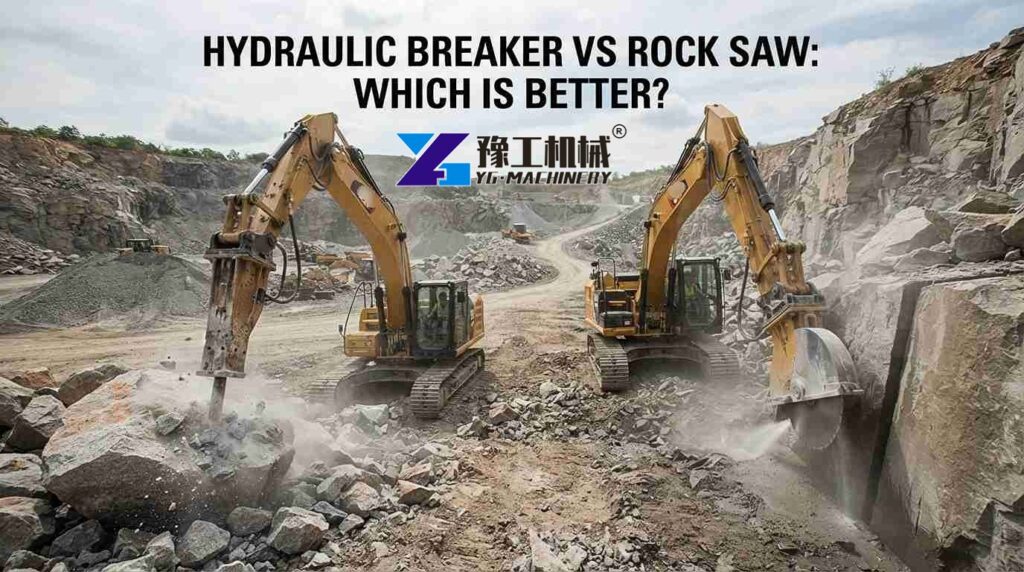
Choosing the right excavator attachment can significantly affect project efficiency, operating costs, and final results. Among the most common tools for rock excavation are the hydraulic breaker and the rock saw attachment. Although both are designed to handle hard materials, they work in completely different ways and are suited to different applications.
A hydraulic breaker uses repeated impact energy to fracture concrete and rock, making it ideal for demolition and general excavation. A rock saw, on the other hand, uses a hydraulically driven circular blade fitted with cutting segments to slice through rock with high precision and minimal vibration. Selecting the wrong attachment can lead to unnecessary wear, slower production, and higher fuel consumption.
This guide compares hydraulic breaker vs. rock saw from every important angle, including working principles, productivity, operating costs, maintenance, environmental impact, and recommended applications. By the end, you’ll know which attachment best matches your project.
Start Your Project with the Right Equipment
Hydraulic Breaker vs Rock Saw: Quick Comparison
| Feature | Hydraulic Breaker | Rock Saw |
|---|---|---|
| Working Method | Impact breaking | Continuous cutting |
| Best For | Demolition, concrete, large boulders | Rock trenching, precision cutting |
| Precision | Low | High |
| Noise Level | High | Low |
| Vibration | High | Low |
| Dust Generation | High | Lower |
| Cutting Accuracy | Poor | Excellent |
| Initial Investment | Lower | Higher |
| Maintenance | Moderate | Higher blade wear |
| Ideal Working Environment | Open construction sites | Urban and sensitive areas |
While both attachments can excavate rock, their operating methods produce very different results. Understanding these differences is the first step toward choosing the right equipment.
What Is a Hydraulic Breaker?
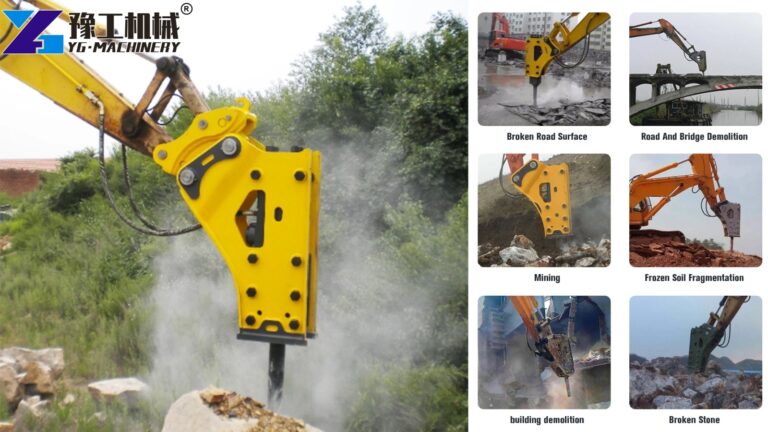
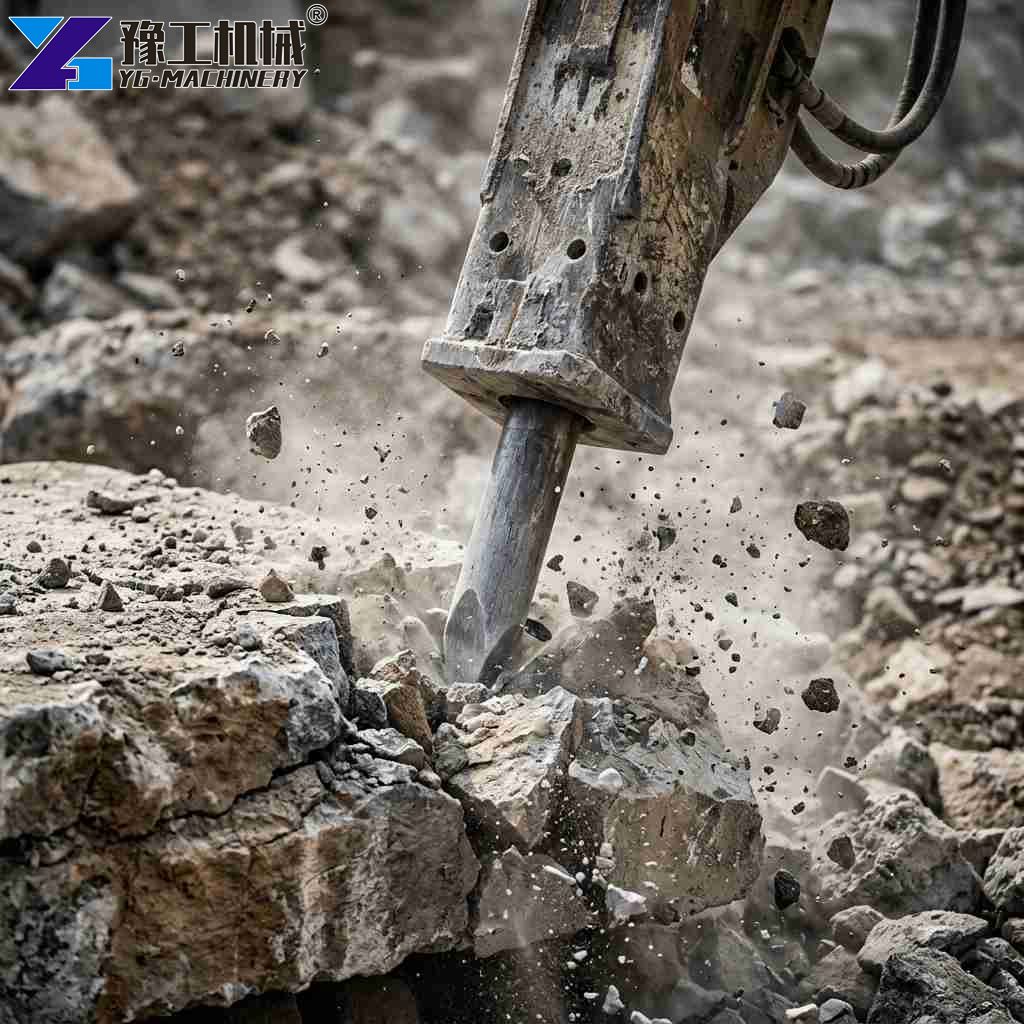
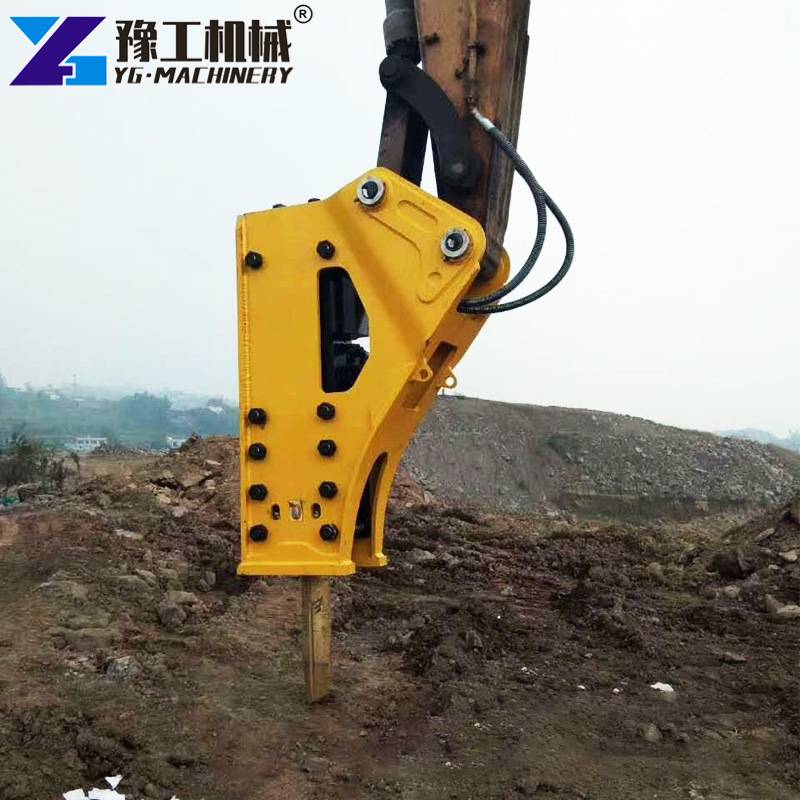
A hydraulic breaker is a percussion attachment powered by the excavator’s hydraulic system. Hydraulic pressure drives a piston that repeatedly strikes a steel chisel, transferring high-impact energy into concrete or rock until the material fractures.
Because the attachment relies on impact force rather than continuous cutting, it excels in demolition work where precision is less important than breaking speed.
Typical applications include:
- Concrete demolition
- Foundation removal
- Quarry secondary breaking
- Road maintenance
- Large rock fragmentation
- Mining operations
Hydraulic breakers are available in various sizes, from compact models for mini excavators to heavy-duty units capable of breaking reinforced concrete and hard granite.
One of the main advantages of hydraulic breakers is their versatility. By changing the chisel type, contractors can adapt the attachment to different materials and demolition tasks without replacing the entire tool.
Boost Productivity—Get a Free Quote
What Is a Rock Saw?
Unlike a breaker, a rock saw removes material through continuous cutting instead of repeated impacts.
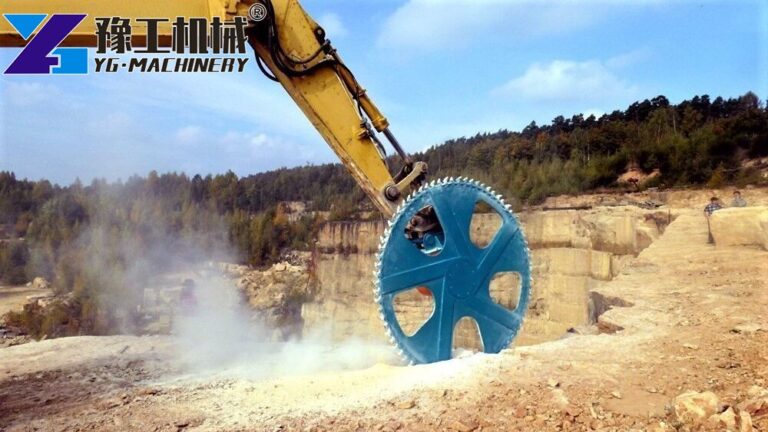
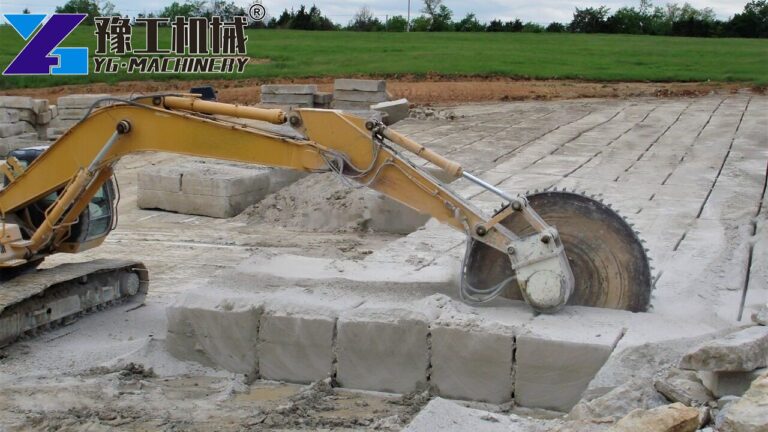
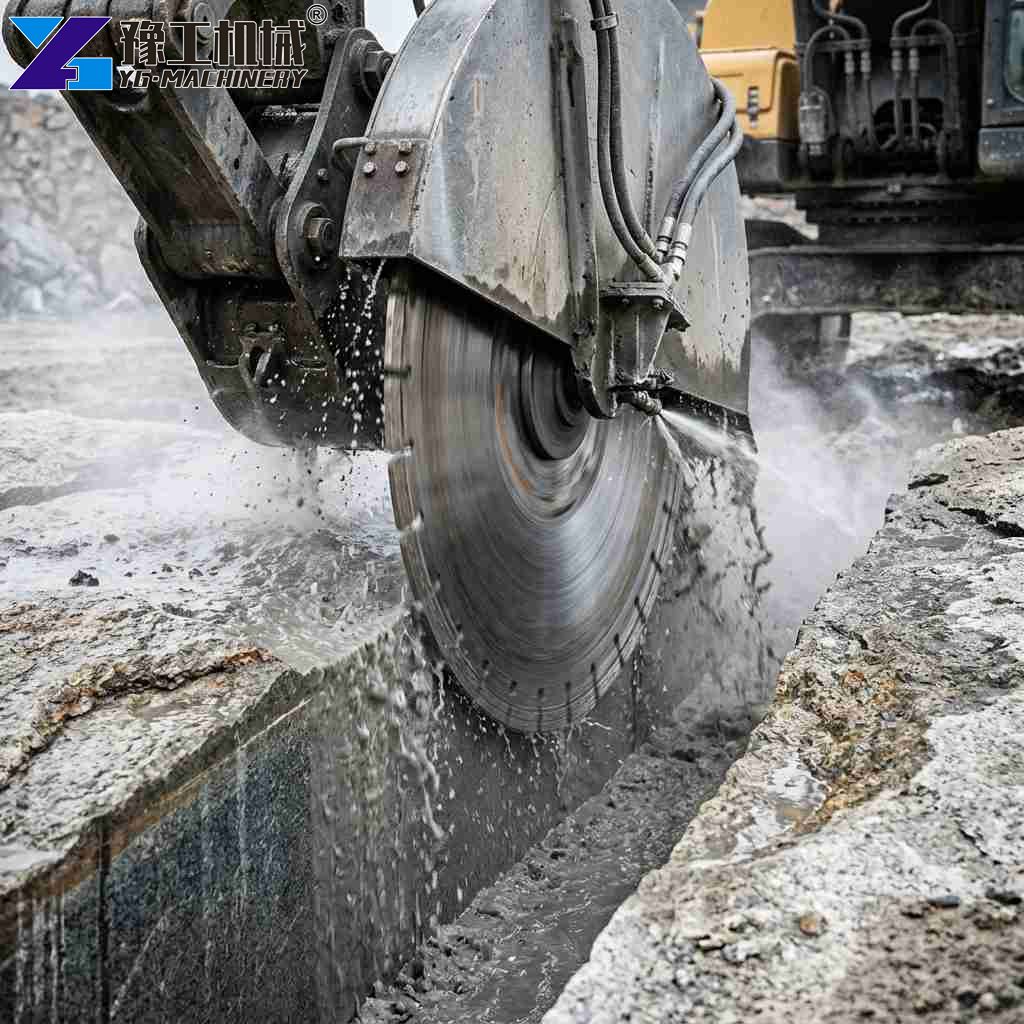
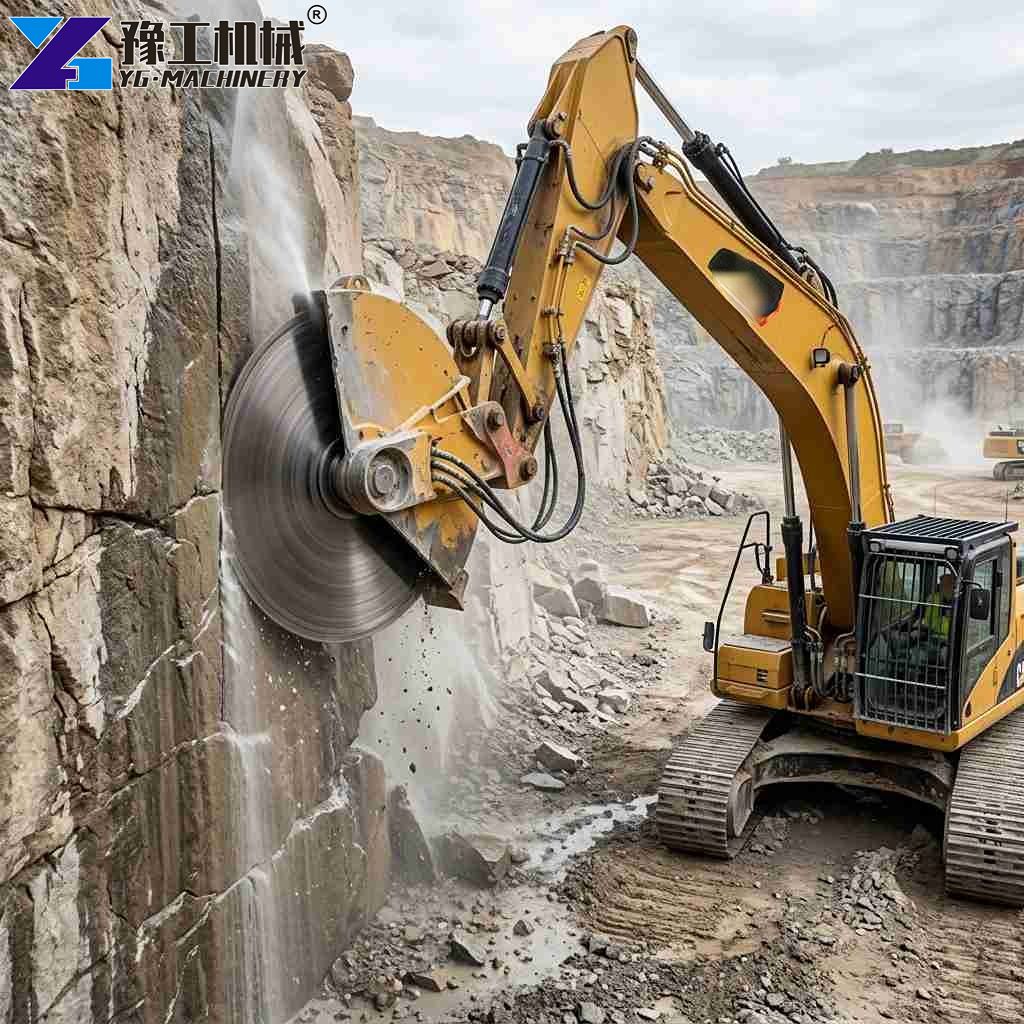
A hydraulic motor rotates a circular blade equipped with tungsten carbide or diamond cutting segments. Rather than shattering the rock, the blade gradually cuts a clean groove through the material.
This design offers several advantages:
- Straight trench walls
- High dimensional accuracy
- Minimal vibration
- Lower noise levels
- Better control near existing structures
Rock saws are widely used for:
- Utility trenching
- Pipeline installation
- Tunnel excavation
- Quarry block cutting
- Decorative stone processing
- Road slot cutting
Because they generate less vibration than hydraulic breakers, rock saws are increasingly selected for projects in urban environments where nearby buildings, underground utilities, or sensitive infrastructure must be protected.
In addition, continuous cutting often reduces the amount of overbreak, helping contractors minimize backfilling and material waste.
How Do Hydraulic Breakers and Rock Saws Work?
Although both attachments are powered by the excavator’s hydraulic system, their operating principles are fundamentally different.
A hydraulic breaker converts hydraulic pressure into repeated impact energy. Each blow transfers force directly to the rock surface, creating cracks that expand until the material breaks apart. Productivity depends on impact frequency, blow energy, rock hardness, and operator technique.
A rock saw converts hydraulic power into rotational motion. The blade continuously removes material along the cutting path. Instead of fracturing the rock randomly, it creates a controlled cut with consistent depth and width.
These different working methods explain why the two attachments produce different excavation quality, operating costs, and productivity under various conditions.
Compare Models and Get a Quote
Hydraulic Breaker Advantages
Hydraulic breakers remain one of the most widely used excavator attachments because they combine strong breaking power with relatively low investment costs. For contractors working on demolition or general excavation projects, a breaker often provides the fastest way to remove hard materials without requiring highly specialized equipment.
Lower Initial Investment
Compared with a rock saw, a hydraulic breaker usually has a lower purchase price. This makes it an attractive option for small contractors or companies that need a versatile attachment capable of handling multiple job types.
In addition to the lower equipment cost, spare parts such as chisels, bushings, and seal kits are widely available, reducing long-term ownership expenses.
Excellent for Demolition
Hydraulic breakers are specifically designed for breaking rather than cutting. Their high-impact force makes them ideal for:
- Reinforced concrete demolition
- Asphalt removal
- Bridge demolition
- Foundation excavation
- Boulder breaking
- Secondary rock breaking in quarries
When precision is not the primary concern, breakers typically deliver higher productivity than cutting tools.
Compatible with Various Chisels
Most hydraulic breakers support interchangeable tool bits, allowing operators to adapt the attachment to different materials. Common chisel types include:
- Point chisel for general rock breaking
- Wedge chisel for concrete demolition
- Blunt tool for oversized boulders
- Asphalt cutter for road maintenance
Changing the tool bit enables one breaker to perform a wide range of construction tasks without replacing the attachment.
Reliable in Harsh Conditions
Hydraulic breakers can operate in dusty, muddy, and rugged environments where precision cutting equipment may experience faster wear. Mining sites, quarry operations, and large-scale earthworks commonly rely on breakers because of their robust construction and relatively simple maintenance requirements.
Rock Saw Advantages
Although rock saws generally require a higher initial investment, they provide significant benefits for projects where precision, environmental protection, and cutting quality are priorities.
High Cutting Precision
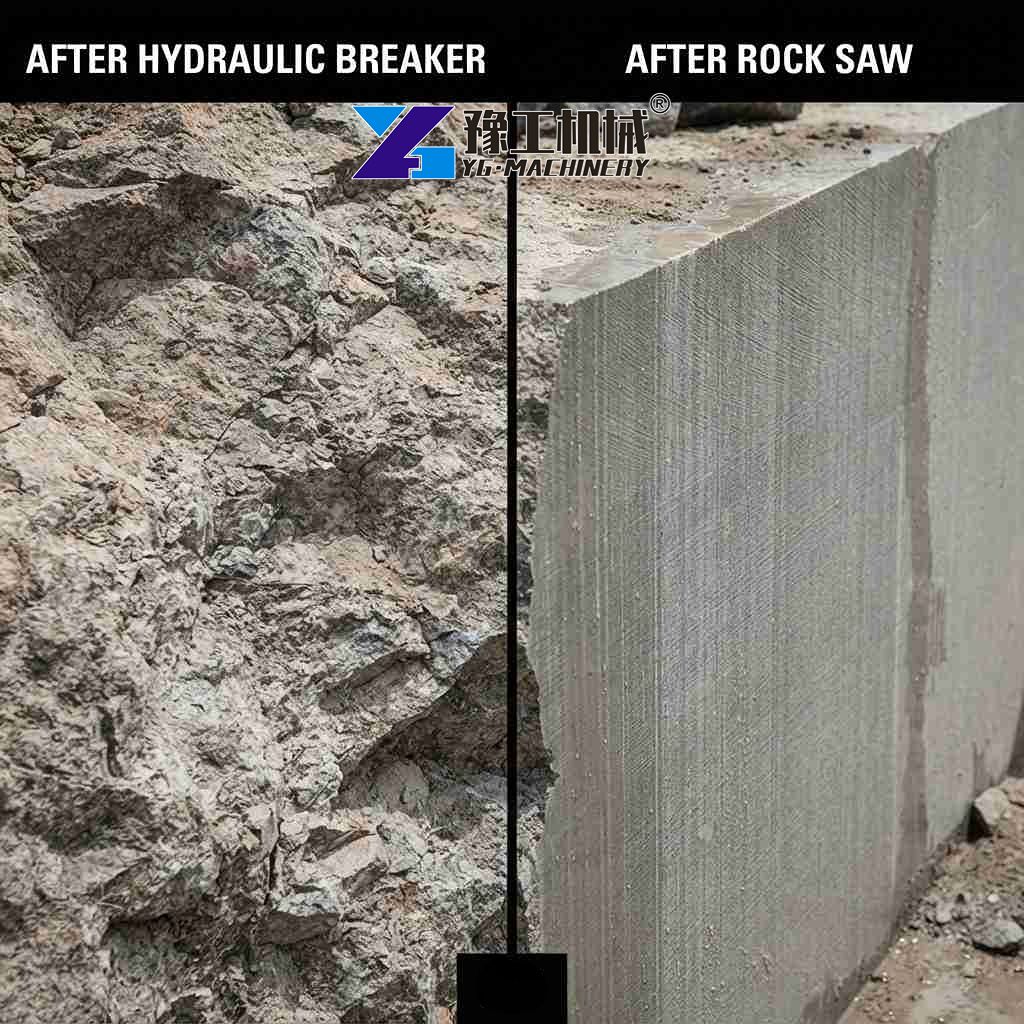
A rock saw produces straight, smooth cuts with consistent depth and width. This precision reduces unnecessary excavation and minimizes the amount of material that must be removed or backfilled.
For utility trenching and pipeline installation, accurate cutting can shorten project timelines and lower restoration costs.
Lower Noise and Vibration
One of the biggest advantages of a rock saw is its low-impact operation. Because it cuts continuously rather than striking the rock repeatedly, it generates substantially less vibration and noise.
This makes rock saws well suited for projects near:
- Residential neighborhoods
- Hospitals
- Schools
- Historic buildings
- Bridges
- Underground utility networks
Lower vibration also helps reduce the risk of damage to nearby structures.
Cleaner Working Environment
Hydraulic breakers often create flying debris and significant dust. In contrast, a rock saw removes material gradually, producing cleaner excavation lines and improving jobsite safety.
When paired with water suppression systems, many rock saws can further reduce airborne dust, helping contractors meet environmental and workplace safety requirements.
Reduced Overbreak
Because a rock saw follows a defined cutting path, it removes only the required material. This minimizes overbreak—a common issue with impact breaking—which can reduce concrete consumption, backfill quantities, and overall project costs.
Hydraulic Breaker vs Rock Saw: Performance Comparison
The best attachment depends largely on the type of work being performed. The table below compares their performance across common construction applications.
| Application | Hydraulic Breaker | Rock Saw |
|---|---|---|
| Concrete Demolition | ⭐⭐⭐⭐⭐ | ⭐⭐ |
| Boulder Breaking | ⭐⭐⭐⭐⭐ | ⭐⭐ |
| Quarry Secondary Breaking | ⭐⭐⭐⭐ | ⭐⭐⭐ |
| Pipeline Trenching | ⭐⭐ | ⭐⭐⭐⭐⭐ |
| Tunnel Excavation | ⭐⭐⭐ | ⭐⭐⭐⭐⭐ |
| Urban Construction | ⭐⭐⭐ | ⭐⭐⭐⭐⭐ |
| Decorative Stone Cutting | ⭐ | ⭐⭐⭐⭐⭐ |
| Utility Installation | ⭐⭐ | ⭐⭐⭐⭐⭐ |
| Road Repair | ⭐⭐⭐⭐ | ⭐⭐⭐ |
Overall, hydraulic breakers outperform rock saws in demolition and large-scale rock fragmentation, while rock saws deliver superior results for controlled excavation and precision trenching.
Find the Right Model for Your Project
Which Attachment Costs Less?
Purchase price is only one part of the total investment. Contractors should evaluate the total cost of ownership (TCO), including maintenance, fuel consumption, wear parts, labor efficiency, and project productivity.
Initial Purchase Cost
Hydraulic breakers generally cost less than comparable rock saw attachments, making them the preferred choice for companies with limited equipment budgets.
Rock saws require a higher upfront investment because of their hydraulic drive systems and specialized cutting blades.
Operating Costs
Hydraulic breakers consume energy through repeated impact. Extended operation can increase fuel consumption, especially when breaking extremely hard rock.
Rock saws maintain a steady cutting action. While the blade gradually wears and requires replacement, continuous cutting often uses energy more efficiently during long trenching operations.
Maintenance Costs
Hydraulic breakers require routine inspection of:
- Chisels
- Bushings
- Hydraulic seals
- Retaining pins
- Lubrication systems
Rock saw maintenance focuses on:
- Blade wear
- Cutting segments
- Hydraulic motor
- Bearings
- Cooling and lubrication systems
Neither attachment is universally cheaper to maintain. Costs depend on operating conditions, rock hardness, and maintenance practices.
Productivity and Labor Costs
For demolition projects, hydraulic breakers often complete work faster, reducing labor hours.
For trenching or precision excavation, rock saws can significantly reduce secondary finishing work. The cleaner cut may eliminate additional excavation, trimming, or concrete repairs, lowering overall project costs despite the higher equipment price.
When evaluating long-term profitability, contractors should compare the complete project cost rather than the purchase price alone.
Which Attachment Is Faster?
Speed is often one of the first factors contractors consider when choosing between a hydraulic breaker and a rock saw. However, the faster attachment depends entirely on the job. Breaking and cutting are different processes, so productivity should be measured by project efficiency rather than operating speed alone.
Hydraulic Breakers Excel in Bulk Demolition
A hydraulic breaker delivers rapid impact energy that quickly fractures concrete and large rock masses. On demolition sites, operators do not need perfectly straight edges or smooth surfaces, making the breaker the faster solution.
Hydraulic breakers are typically the better choice for:
- Removing reinforced concrete foundations
- Breaking oversized boulders
- Demolishing roads and pavements
- Quarry secondary breaking
- Site preparation before excavation
In these applications, the objective is to break material into manageable pieces as quickly as possible.
Rock Saws Improve Efficiency in Precision Excavation
A rock saw removes material at a slower cutting speed than a breaker’s impact rate. However, because it creates a clean and accurate cut, it often eliminates several follow-up operations.
For example, during pipeline trenching, a breaker may require additional trimming, cleaning, and backfilling after excavation. A rock saw can produce a trench close to the required dimensions in a single pass, reducing total project time.
This makes rock saws especially productive for:
- Utility trenching
- Fiber optic installation
- Water and gas pipelines
- Tunnel profiling
- Decorative stone cutting
Rock Hardness Also Affects Productivity
Rock characteristics play a significant role in attachment performance.
| Rock Type | Hydraulic Breaker | Rock Saw |
|---|---|---|
| Soft Limestone | Excellent | Excellent |
| Sandstone | Excellent | Excellent |
| Basalt | Good | Good |
| Granite | Good | Very Good |
| Reinforced Concrete | Excellent | Fair |
Highly fractured rock often breaks quickly with a hydraulic breaker. Dense rock formations that require straight cuts may favor a rock saw, especially where excavation accuracy is important.
Which Attachment Produces Less Noise and Vibration?
Environmental requirements are becoming increasingly important in modern construction. Many urban projects have strict limits on noise and vibration to protect nearby residents, buildings, and underground infrastructure.
Hydraulic Breakers Generate Strong Impact Waves
Each strike from a hydraulic breaker creates shock waves that travel through the surrounding material. While this impact force is effective for demolition, it also produces:
- High noise levels
- Significant ground vibration
- Flying debris
- Increased dust generation
On projects close to hospitals, schools, historical buildings, or underground utilities, these effects may require additional protective measures or restricted working hours.
Rock Saws Offer a More Controlled Operation
A rock saw removes material through continuous cutting rather than repeated impacts. As a result, it generally produces:
- Lower vibration
- Reduced noise
- Cleaner trench walls
- Better protection for nearby structures
These characteristics make rock saws a preferred option for municipal engineering, underground utility installation, and projects in densely populated urban areas.
If environmental regulations are a major concern, a rock saw often provides the safer and more compliant solution.
Hydraulic Hammer or Excavator Rock Saw: Which Should You Choose?
There is no universal winner. The best attachment depends on your project requirements, working environment, budget, and productivity goals.
Use the following guide to simplify your decision.
| If Your Project Needs… | Recommended Attachment |
|---|---|
| Concrete demolition | Hydraulic Hammer |
| Large boulder breaking | Hydraulic Hammer |
| Quarry secondary breaking | Hydraulic Hammer |
| Straight rock trenching | Excavator Rock Saw |
| Utility pipeline installation | Excavator Rock Saw |
| Tunnel excavation | Excavator Rock Saw |
| Low vibration operation | Excavator Rock Saw |
| Lower purchase cost | Hydraulic Hammer |
| High cutting precision | Excavator Rock Saw |
| General-purpose demolition | Hydraulic Hammer |
Choose a Hydraulic Hammer If:
- Your primary work involves demolition.
- Breaking speed is more important than cutting accuracy.
- You need a lower initial equipment investment.
- Projects include concrete, asphalt, or large rock fragmentation.
- You want one versatile attachment for multiple demolition tasks.
Choose an Excavator Rock Saw If:
- Your work requires straight and precise rock cutting.
- Projects involve trenching for pipelines or utilities.
- Construction takes place in urban or environmentally sensitive areas.
- Reducing vibration and protecting nearby structures is critical.
- You want to minimize overbreak and post-excavation finishing work.
Before making a purchase, contractors should also confirm compatibility with the excavator’s operating weight, hydraulic flow, and pressure. Selecting the correct attachment size helps maximize efficiency while extending equipment life.
Frequently Asked Questions
Not necessarily. A rock saw is better for precision cutting, trenching, and low-vibration work, while a hydraulic breaker is better for demolition, concrete removal, and breaking large rocks.
A hydraulic breaker does not cut rock. It fractures rock through repeated impacts until the material breaks into smaller pieces.
A rock saw is generally the better choice because it creates straight trenches with consistent width and depth while minimizing overbreak.
Hydraulic breakers usually have a lower purchase price. However, the total project cost depends on productivity, maintenance, fuel consumption, and finishing work.
Yes. Many excavators can operate either attachment, provided the hydraulic flow, operating pressure, and carrier weight match the manufacturer’s specifications.
Hydraulic breakers typically require routine lubrication and replacement of wear components such as chisels and bushings. Rock saws require blade inspection and replacement of cutting segments. Maintenance requirements vary depending on application and rock type.
Yes. Because a rock saw cuts continuously instead of striking the material, it generally produces much less vibration than a hydraulic breaker.
Evaluate your project objectives, rock conditions, excavation accuracy, environmental restrictions, and equipment budget. If your work focuses on demolition, a hydraulic breaker is usually the better investment. If precision trenching and controlled cutting are priorities, a rock saw is often the more efficient solution.
Final Thoughts
When comparing hydraulic breaker vs rock saw, the right choice depends on how you plan to excavate rather than simply how hard the material is. Hydraulic breakers provide powerful impact energy for demolition, concrete removal, and large-scale rock breaking, making them a cost-effective solution for general construction and mining. Rock saws, meanwhile, deliver precise, low-vibration cutting that is ideal for pipeline installation, tunnel excavation, municipal engineering, and projects where accuracy is essential.
Instead of asking which attachment is universally better, contractors should consider which one delivers the highest productivity for their specific application. Factors such as rock type, excavation depth, environmental regulations, project timeline, and total operating cost all influence the best decision.
At YG Machinery, we supply both hydraulic breakers and rock saw attachments for excavators ranging from compact models to heavy-duty carriers. Our engineering team can recommend the most suitable attachment based on your excavator model, hydraulic specifications, rock conditions, and jobsite requirements. Contact us today to receive professional selection advice and a customized solution for your next excavation project.