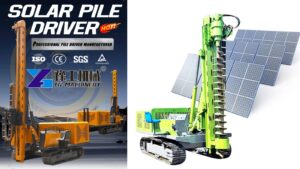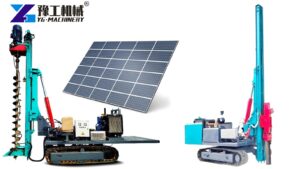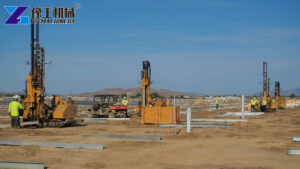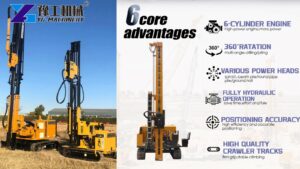
Solar pile driver for sale was the keyword that brought an Australian EPC contractor to YG Machinery in early 2026. The company was preparing a 35MW ground-mounted photovoltaic project in New South Wales. More than 18,000 steel piles needed to be installed before the solar modules could be assembled. The construction schedule allowed less than four months for foundation work, so equipment reliability became more important than the purchase price.
The contractor had previously rented piling equipment from local suppliers. The machines worked well on soft soil but struggled when they encountered weathered sandstone and compact clay layers. Downtime increased rapidly. Fuel costs rose. The daily pile installation target was often missed. This project required a dedicated hydraulic piling solution that could drill, position, and drive piles efficiently under different ground conditions. After comparing several Chinese manufacturers, the engineering manager contacted YG Machinery and requested a technical meeting.
Start Your Project with the Right Equipment

Why the Customer Needed a Ground-Mounted Solar Pile Driver
The customer specialized in utility-scale solar farms across eastern Australia. Their previous projects ranged from 10MW to 50MW. Every project required thousands of galvanized steel piles. Delays during foundation construction affected every following stage, including racking installation, module mounting, electrical wiring, and commissioning.
During the first online meeting, the engineering team shared geological survey reports. Approximately 60% of the site consisted of compact clay. Around 30% contained weathered rock. The remaining areas included gravel mixed with sandstone fragments. Standard impact-only equipment could not maintain stable productivity across all zones.
The project team listed several key requirements.
- Drilling depth up to 6 meters.
- Hole diameter between 150 mm and 300 mm.
- Stable hydraulic performance during continuous operation.
- Easy transportation between working locations.
- Fast setup before each drilling position.
- Low maintenance during long working shifts.
These requirements ruled out several low-cost machines. The customer wanted one machine capable of handling different drilling conditions without frequent equipment replacement.
Selecting a Solar Piling Machine Manufacturer
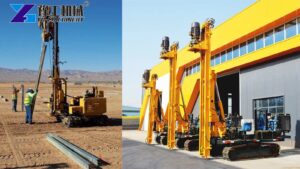
After receiving the geological report, our engineers recommended the crawler hydraulic photovoltaic pile driver instead of the wheel-type version. Although both models could complete photovoltaic foundation work, the crawler chassis provided better stability on uneven terrain and soft construction roads.
A technical video conference followed one week later. Engineers from both companies reviewed the drilling plan, pile specifications, hydraulic hammer requirements, and daily production targets. We also discussed transportation inside the construction site because some working areas had gradients approaching 20 degrees.
Several configurations were adjusted before the quotation was finalized.
- Crawler chassis for improved site mobility.
- 4108 diesel engine for continuous outdoor work.
- Hydraulic hammer flow of 50–110 L/min.
- Drilling diameter expanded to meet multiple pile sizes.
- Additional spare hydraulic hoses included.
- English operation manuals and maintenance documents prepared.
- Australian-standard electrical accessories supplied where required.
The customer compared our proposal with two European suppliers and another Chinese manufacturer. After reviewing technical specifications, maintenance costs, spare parts availability, and delivery time, they confirmed the order for one crawler hydraulic photovoltaic pile driver.
Boost Productivity—Get a Free Quote


Evaluating a Solar Farm Pile Driver Through Video Demonstration
Before production officially started, the customer requested a live demonstration instead of relying only on brochures and specification sheets. We arranged a real-time factory video inspection using equipment configured similarly to the ordered model. During the demonstration, our technicians drilled into compact soil, weathered rock, and mixed gravel to simulate conditions similar to those described in the Australian geological report.
The customer focused on several performance indicators rather than appearance.
- Drilling stability during continuous operation.
- Hydraulic hammer response speed.
- Boom movement and positioning accuracy.
- Crawler travel on uneven ground.
- Fuel consumption under full load.
- Accessibility of daily maintenance points.
The engineering manager asked many practical questions during the meeting. These included hydraulic oil temperature after several hours of operation, recommended service intervals, spare parts replacement time, and operator training requirements. Our engineers answered each question with operating records and maintenance data collected from previous overseas projects. After reviewing the demonstration, the customer approved the final production schedule.
Manufacturing and Quality Inspection Before Shipment
Production took approximately five weeks. Throughout manufacturing, we sent weekly progress photos and videos so the customer could follow each stage remotely. Major structural components were completed first, followed by hydraulic system assembly, engine installation, crawler assembly, and electrical wiring.
Before shipment, the machine completed a full inspection process. Each hydraulic circuit was pressure tested. Engine operation was checked under different loads. Boom rotation, slide movement, drilling functions, and crawler travel were tested repeatedly. All lubrication points and fasteners were inspected before packing.
The customer also appointed an independent inspection company to review the finished equipment. The inspection included dimensional measurements, welding quality, hydraulic performance, engine operation, and overall appearance. After receiving the inspection report, the customer released the remaining balance payment and confirmed shipment.
Find the Right Model for Your Project
Shipping the Machine from China to Australia
The crawler hydraulic photovoltaic pile driver was loaded into a flat-rack container because of its dimensions. Sensitive hydraulic components were protected with waterproof wrapping, while exposed steel surfaces received anti-corrosion treatment suitable for long-distance sea transport.
Together with the equipment, we supplied:
- Operation manual in English.
- Hydraulic and electrical drawings.
- Spare seals and filters.
- Routine maintenance toolkit.
- Recommended spare parts list.
- Online commissioning guide.
The shipment departed from Qingdao Port and arrived at Sydney approximately three weeks later, before being transported by truck to the construction site in New South Wales.
Installation, Operator Training, and Site Commissioning
Because the machine had been fully assembled before shipment, on-site preparation required very little time. After unloading, the contractor completed routine inspections, connected the hydraulic hammer, checked fluid levels, and carried out several trial drilling operations under our online guidance.
Training mainly focused on practical site operation rather than basic machine assembly. Topics included equipment positioning, hydraulic hammer adjustment, drilling depth control, daily lubrication, and routine maintenance procedures. Operators also learned how to select different drilling methods according to changing ground conditions.
Within two working days, the local team was able to operate the machine independently. Production drilling started immediately after the trial runs were completed, allowing the foundation work to stay on schedule despite variable ground conditions.
Customer Feedback After the First Phase of Construction
Approximately two months after commissioning, the customer shared the first construction report with our team. By that time, the machine had completed the foundation work for the first section of the solar farm. According to the site manager, productivity remained stable throughout the project, even when drilling through compact clay and weathered rock. The crawler chassis also performed well on uneven access roads after rainfall, reducing delays caused by poor ground conditions.
The contractor recorded several improvements compared with the rental equipment used on previous projects.
- Daily pile installation efficiency increased.
- Equipment downtime was significantly reduced.
- Hydraulic system operated smoothly during long working shifts.
- Fuel consumption remained within the expected budget.
- Routine maintenance required only basic daily inspections.
- Operators became familiar with the controls after only a short training period.
The engineering manager also noted that consistent drilling quality helped reduce pile alignment corrections during the installation of the mounting structures. This saved additional labor during the following construction stages.
Rental Equipment vs. YG Crawler Solar Pile Driver
| Comparison Metrics | Local Rented Piling Machine | YG Crawler Solar Pile Driver |
| Site Adaptability | Struggled in sandstone & compact clay | Smooth operation in clay, rock & gravel |
| Daily Output | Low (frequent targets missed) | Significantly increased daily efficiency |
| Downtime & Failures | High downtime; frequent maintenance | Extremely low; stable long-shift operation |
| Fuel Efficiency | High fuel consumption | Optimized & controlled within budget |
| Operator Experience | Complex alignment corrections | Easy control; low post-installation labor |
| Long-term Cost | High cumulative rental & repair fees | Lower overall TCO & flexible project scheduling |
Why the Customer Planned to Purchase Another Machine
After the first construction phase, the customer informed us that another utility-scale photovoltaic project had already entered the planning stage. Because the first machine had performed reliably, they began discussing the purchase of a second unit instead of renting equipment again.
Several factors influenced this decision.
- Stable performance across different geological conditions.
- Simple daily maintenance procedures.
- Fast technical support through online communication.
- Good spare parts availability.
- Lower long-term operating costs than rented equipment.
- Easy transportation between different solar farm projects.
The customer explained that owning dedicated piling equipment provided better project scheduling flexibility and reduced dependence on local rental availability during Australia’s peak construction season.


Hydraulic Photovoltaic Pile Driver Specifications
Hydraulic Photovoltaic Pile Driver
| Parameter | Specification |
|---|---|
| Overall Dimensions | 4700 × 2100 × 2800 mm |
| Drill Pipe Rotational Speed | 180 r/min |
| Track Shoe Width | 400 mm |
| Gradability | 30° |
| Engine | 4108 Diesel |
| Rock Hardness | 6–20F |
| Drilling Diameter | 80–500 mm |
| Slide Tilt Angle | 120° |
| Drilling Depth | 0–6 m |
| Drill Arm Swing Angle | Left & Right 150° |
| Reducer Torque | 13,000 N·m |
| Slide Swing Angle | Left & Right 40° |
| Main Hydraulic Pump | Triple Pump |
| Driving Speed | 0–3 km/h |
| Oil Pump | 40/40/32 |
Crawler Photovoltaic Pile Driver (Customer’s Model)
| Parameter | Specification |
|---|---|
| Overall Dimensions | 4700 × 2200 × 2800 mm |
| Hydraulic Hammer Flow | 50–110 L/min |
| Track Shoe Width | 400 mm |
| Impact Frequency | 350–800 BPM |
| Engine | 4108 Diesel |
| Hydraulic System Pressure | 25 MPa |
| Generator Power | 88 kW |
| Cooling System | Strong Wind Heat Dissipation |
| Drilling Depth | 0–6 m |
| Oil Pump | 40/40/32 |
| Drilling Diameter | 80–600 mm |
| Driving Speed | 3 km/h |
Compare Models and Get a Quote