A 30 Ton electric tank trolley recently helped an American manufacturing company complete a large-scale factory relocation project. The customer needed a safe and efficient way to transport heavy CNC machines, hydraulic presses, and production equipment inside a newly expanded workshop while minimizing production downtime.
Instead of relying entirely on rented cranes and forklifts, the customer selected a battery-powered transport solution capable of carrying heavy loads with precise wireless control. From the initial inquiry to successful operation, the project recorded every major stage, including technical discussions, equipment selection, factory inspection, shipment, installation, operator training, and practical application inside the production facility.

Start Your Project with the Right Equipment
Customer Background: Why the Factory Needed a 30 Ton Electric Tank Trolley
The customer operates a metal processing factory in the central United States. As production capacity increased, the company invested in additional machining centers and upgraded several production lines. Existing workshops no longer provided sufficient space, making equipment relocation an essential part of the expansion project.
Several machines weighed between 20 and 28 tons. Moving them with forklifts alone was neither practical nor safe. Renting cranes for every relocation would significantly increase project costs and extend installation time.
The engineering manager wanted a reusable transport solution that could move heavy machinery repeatedly without interrupting daily production. After comparing several alternatives, the company began searching for a powered heavy-duty moving system suitable for indoor industrial applications.
Initial Inquiry And Equipment Selection
The first inquiry arrived through the YG Machinery website. The customer provided basic project information together with several workshop photographs and machine weight data.
To recommend the appropriate model, YG engineers requested additional technical details, including:
- Maximum equipment weight
- Machine dimensions
- Workshop floor condition
- Transportation distance
- Turning radius
- Daily operating frequency
- Available charging facilities
Several technical emails were exchanged before both teams arranged an online meeting.
During the discussion, engineers reviewed the factory layout and transportation route. They concluded that a 30-ton model would provide sufficient safety margin while remaining compact enough to operate inside relatively narrow production aisles.
The customer also preferred battery-powered operation because it produced no exhaust emissions and generated much lower operating noise inside enclosed workshops.
Electric Machine Mover Skate Configuration Discussion
Following the video meeting, both teams finalized the equipment configuration according to the customer’s production environment rather than simply selecting the highest-capacity model.
The customer planned to relocate various types of industrial equipment, including CNC machining centers, hydraulic presses, and automated production units. Although the heaviest machine weighed approximately 28 tons, engineers recommended a 30-ton electric tank trolley to provide additional load capacity and improve operational safety during long-distance transportation.
Several customized features were confirmed before production:
- Wireless remote control system
- Dual-drive electric motors
- High-capacity lithium battery
- Electromagnetic braking system
- Low-speed precision movement
- Reinforced steel frame
- Industrial polyurethane wheels
The customer also requested adjustable moving speed to accommodate different equipment sizes. Slow-speed positioning was particularly important during final installation because some machines required millimeter-level alignment with existing foundations.
After reviewing the final technical drawings, both parties confirmed the configuration and approved production.
Boost Productivity—Get a Free Quote
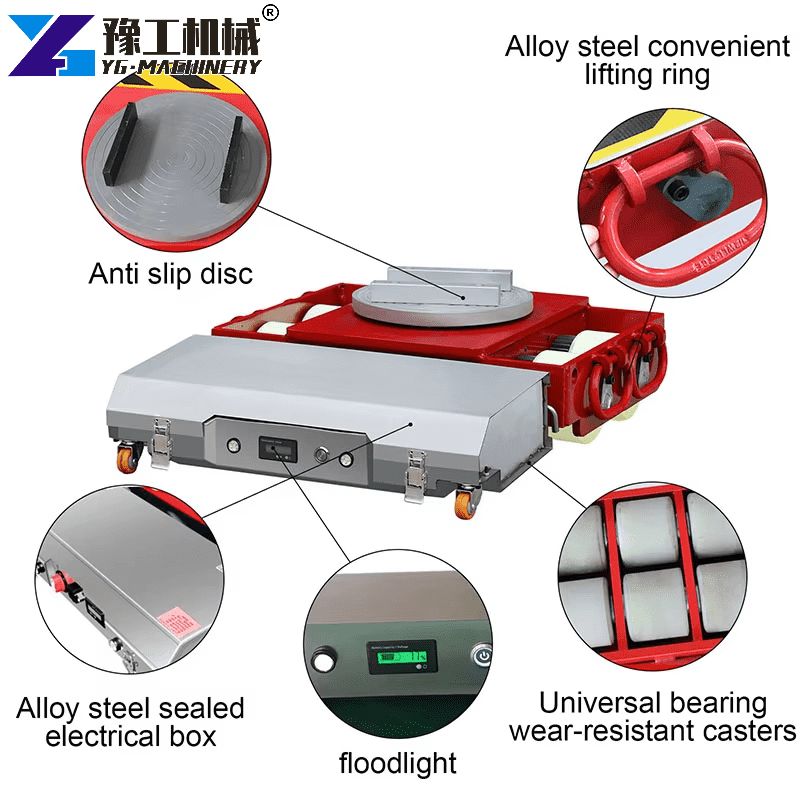

YG Electric Tank Trolley Technical Specifications
After confirming the transportation requirements and workshop layout, both teams finalized the equipment specifications. The selected model provided sufficient load capacity for relocating heavy CNC machines, hydraulic presses, and other industrial equipment while maintaining stable maneuverability inside the factory.
The customer selected the 30-ton model because it offered an excellent balance between carrying capacity, operating flexibility, and long-term reliability. Wireless remote control, battery-powered operation, and smooth speed regulation also helped improve positioning accuracy during equipment installation.
| Model | 10T | 20T | 25T | 30T | 40T | 50T | 60T |
| Motor | 500W x 2 with brake, 104 flange-reinforced gearbox | 750W x 2 104 Flange-Reinforced Gearbox with Brake | 1000W x 2 104 Flange-Reinforced Gearbox with Brake | 1200W x 2 Heavy-duty gearbox with brake and 120 flange | 1500W x 2 120mm Flange-Reinforced Gearbox with Brake | 2000W x 2 120mm Flange-Reinforced Gearbox with Brake | 3000W x 2 with brake, 120 flange-reinforced gearbox |
| Controller | D2T80A dual-channel driver | D2T80A Dual-Channel Driver | D2T100A Dual-Channel Driver | D2T100A Dual-channel driver | D2T200A Dual-Channel Driver | D2T200A Dual-Channel Driver | D2T220A dual-channel driver |
| Remote Control | C7 remote control | C6/C7 Remote Control or Industrial Remote Control | C7 Remote Control | C7 remote control | C6/C7 Remote Control or Industrial Remote Control | C7 Remote Control or Industrial Remote Control | C7 remote control or industrial remote control |
| Battery Specifications | 48V 30AH ternary lithium battery | 48V 60Ah ternary lithium or Lithium Iron Phosphate | 48V 60Ah ternary lithium or Lithium Iron Phosphate | 48V 60Ah ternary lithium or lithium iron phosphate | 48V 120Ah ternary lithium or Lithium Iron Phosphate | 48V 120Ah ternary lithium or Lithium Iron Phosphate | 48V 120AH ternary lithium |
| Operating Current | 25A | 60A | 60A | 60A | 120A | 120A | 120A |
| Charging Current | 54.6 | 54.6 | 54.6 | 54.6 | 54.6 | 54.6 | 54.6 |
| Towing Weight | 10T | 20T | 25T | 30T | 40T | 50T | 60T |
| Load Capacity | 10T | 10T | 12.5T | 15T | 20T | 25T | 30T |
| Dimensions | 500*550*145mm | 670*620*165mm | 670*635*165mm | 740*640*185mm | 810*800*182mm | 810*800*182mm | 1110*800*185mm |
| Disc Flange | 2900mm Diameter | ||||||
| Travel Speed | Per Minute | min | 2-10 min Adjustable | ||||
| Continuous Running Time | 2-3 Hours | 3-4 hours | 4-5 hours | ||||
Compare Models and Get a Quote
Electric Load Moving Skate Tank Solution Design
Before manufacturing began, YG engineers prepared a transportation solution based on the customer’s factory layout.
Instead of focusing only on equipment capacity, the discussion covered the complete relocation process. Engineers evaluated transportation distance, workshop aisle width, turning areas, floor conditions, and loading procedures to ensure the machine would operate efficiently after arrival.
Several recommendations were provided:
- Keep transportation routes clean and level.
- Verify floor bearing capacity before moving oversized equipment.
- Maintain a stable travel speed during relocation.
- Use spotters when operating in confined spaces.
- Charge the battery fully before long transport tasks.
These recommendations helped the customer integrate the equipment into daily operations without requiring major changes to the existing workshop.
Manufacturing And Factory Inspection
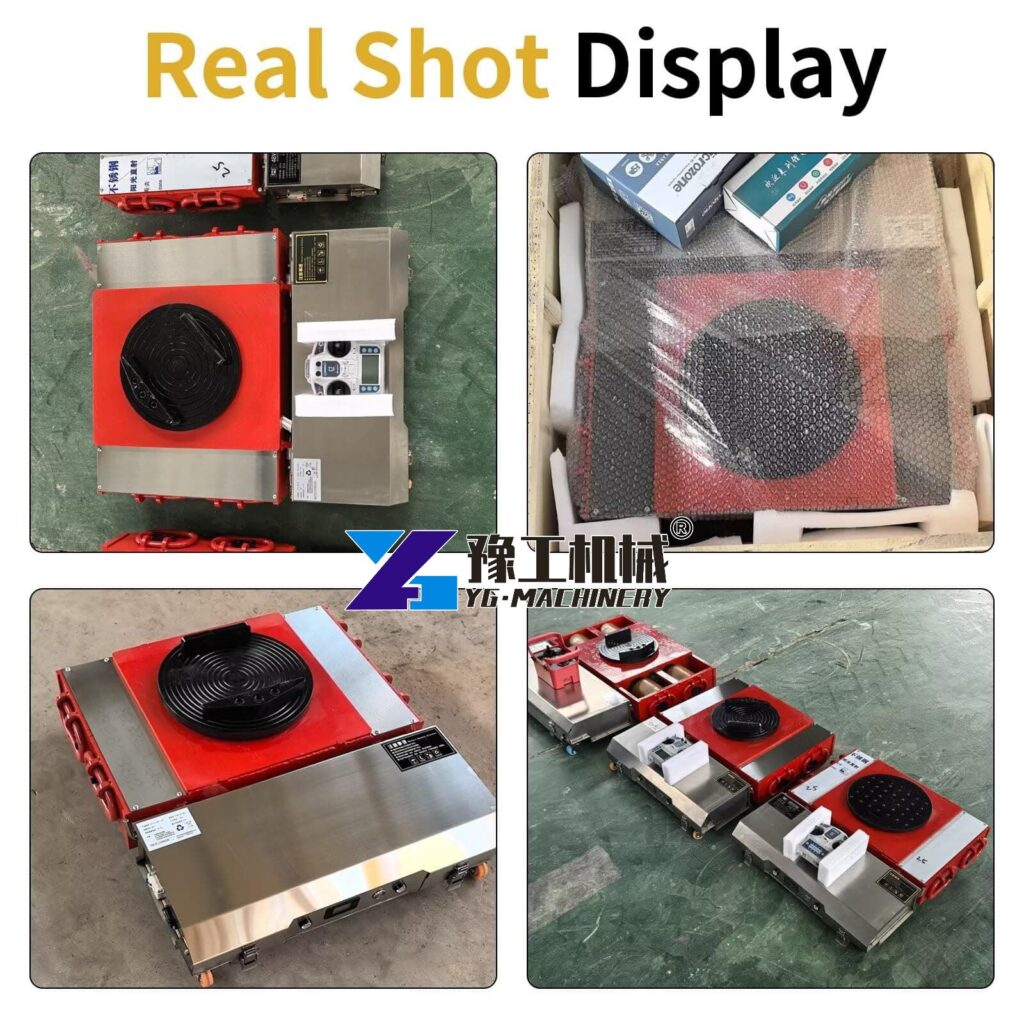
Electric load moving skate tank production started after payment confirmation.
The frame, drive system, battery components, and electrical control system were assembled according to the approved specifications. Throughout manufacturing, technicians performed routine inspections to verify assembly quality and electrical connections.
Before shipment, the completed machine underwent factory testing.
Inspection focused on several key items:
- Driving performance
- Steering response
- Remote control operation
- Braking system
- Battery charging function
- Full-load operational testing
After completing the inspection, the machine was approved for export.

Find the Right Model for Your Project
Packing And Ocean Shipment To The USA
The electric machine mover skate was prepared for international transportation using export-standard protective packaging.
Electrical components were secured, exposed metal surfaces received anti-corrosion treatment, and all accessories were packed separately for easier installation after arrival. The machine was then loaded into a shipping container and transported from China to the United States according to the agreed delivery schedule.
YG maintained communication with the customer throughout the shipping process and provided the necessary export documents to support customs clearance and equipment delivery.
Installation And Operator Training
After arriving at the customer’s factory, the equipment was unloaded using an overhead crane and positioned inside the new production workshop.
Installation was straightforward because the machine had been fully assembled before shipment. Operators completed battery installation, system inspection, and remote-control pairing within a short period. YG engineers provided online technical guidance throughout the commissioning process to ensure every function operated correctly before the first relocation task.
Operator training focused on practical applications rather than theory.
The main training topics included:
- Remote control operation
- Safe starting and stopping procedures
- Speed adjustment
- Precision positioning
- Battery charging and maintenance
- Daily inspection before operation
After several practice sessions, operators became familiar with the control system and could independently transport heavy equipment throughout the workshop.
Performance Of The Electric Tank Cargo Trolley Truck Skates
The first relocation task involved transporting a 26-ton CNC machining center from the original production area to the newly completed workshop.
Previously, similar work required rented cranes, forklifts, lifting chains, and several technicians coordinating every movement. Preparation alone often consumed several hours before equipment could even begin moving.
Using the YG electric load-moving skate tank, the relocation process became much more organized.
The machine accelerated smoothly, maintained stable movement under heavy loads, and allowed operators to make precise directional adjustments using the wireless remote controller. Slow-speed positioning proved especially useful when aligning the machine with pre-installed anchor bolts and production foundations.
During the following weeks, the customer successfully relocated:
- CNC machining centers
- Hydraulic presses
- Laser cutting machines
- Industrial compressors
- Steel fabrication equipment
- Assembly production units
The equipment maintained stable performance throughout continuous daily operation without unexpected shutdowns or noticeable power loss.
Productivity Improvements After Deployment
After approximately three months of operation, the customer reviewed the overall project performance and compared it with previous relocation methods.
Several measurable improvements became evident.
Compared with crane-assisted transportation, equipment relocation became significantly more flexible because machines could be moved whenever production schedules required rather than waiting for external lifting contractors.
The customer reported several operational improvements:
- Heavy equipment relocation time reduced by approximately 40%
- Manual labor requirements reduced by nearly 50%
- Machine positioning became more accurate
- Internal transportation costs decreased
- Equipment downtime during production upgrades became shorter
Battery operation also reduced indoor noise and eliminated exhaust emissions, creating a more comfortable working environment for installation teams.
These improvements allowed maintenance engineers to complete production line upgrades more efficiently while minimizing interruptions to daily manufacturing activities.
Customer Feedback After Project Completion
Following the successful completion of the relocation project, the factory’s engineering manager shared positive feedback regarding both equipment performance and overall operating experience.
According to the customer, the machine delivered exactly the level of stability required for transporting valuable production equipment. Wireless control made positioning much easier, especially when operating inside narrow workshop aisles.
The customer particularly appreciated:
- Stable heavy-load transportation
- Responsive wireless remote control
- Smooth acceleration and braking
- Easy battery charging
- Low maintenance requirements
- Reliable daily performance
The customer also noted that the equipment would continue supporting future production line expansion projects rather than serving only a single relocation task, making it a practical long-term investment.
Why This Project Was Successful
Several factors contributed to the success of this export project.
Rather than recommending equipment based only on maximum load capacity, YG engineers evaluated the customer’s workshop layout, transportation routes, equipment dimensions, and future expansion plans before finalizing the configuration.
Factory inspection before shipment reduced commissioning time after delivery. Online technical support allowed operators to become familiar with the control system quickly. Most importantly, the selected configuration matched the customer’s actual operating requirements instead of adding unnecessary complexity or cost.
The project demonstrates that careful planning, proper equipment selection, and effective technical communication are just as important as the machine itself when relocating heavy industrial equipment.
Need A Customized Electric Tank Trolley For Your Factory?
Every factory has different transportation requirements. Equipment weight, workshop layout, floor conditions, transportation distance, and turning space all influence the ideal material handling solution.
YG Machinery supplies customized electric tank trolleys and heavy-duty machinery moving systems for industrial equipment relocation, production line installation, warehouse expansion, and factory maintenance projects. Our engineering team can recommend suitable configurations based on your load capacity, working environment, and operational requirements.
Contact us today to receive professional technical advice, detailed specifications, and a customized solution for your heavy equipment moving project.