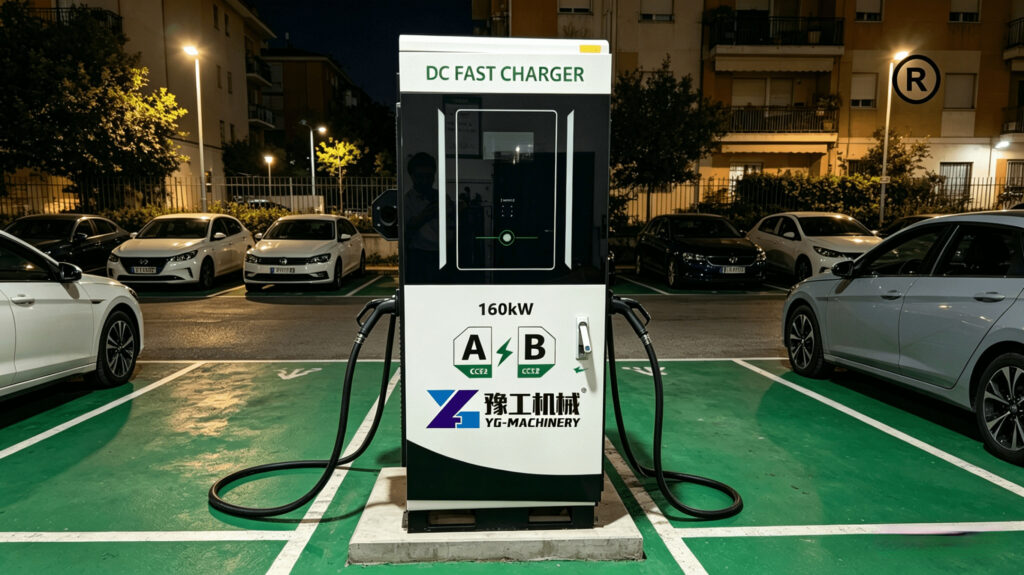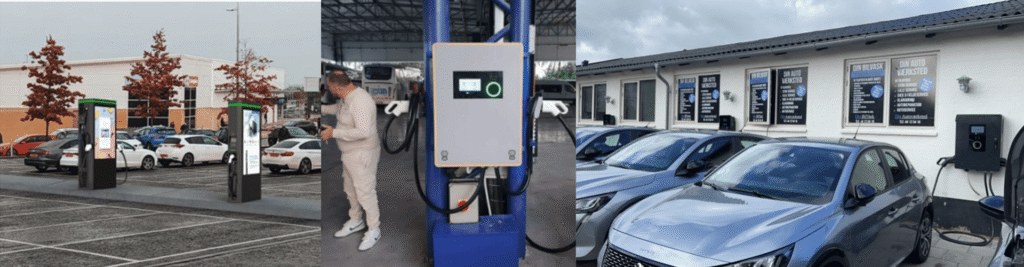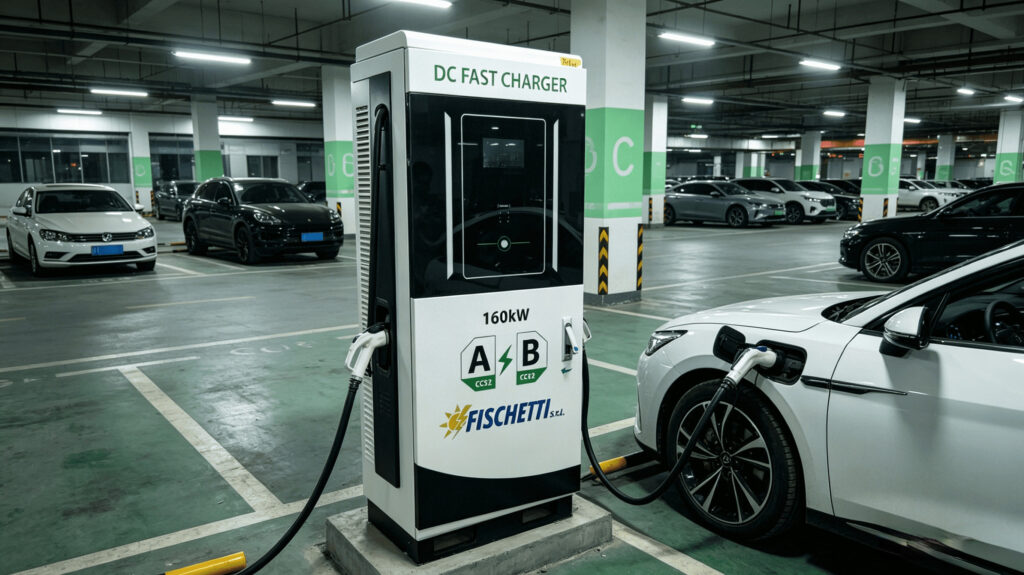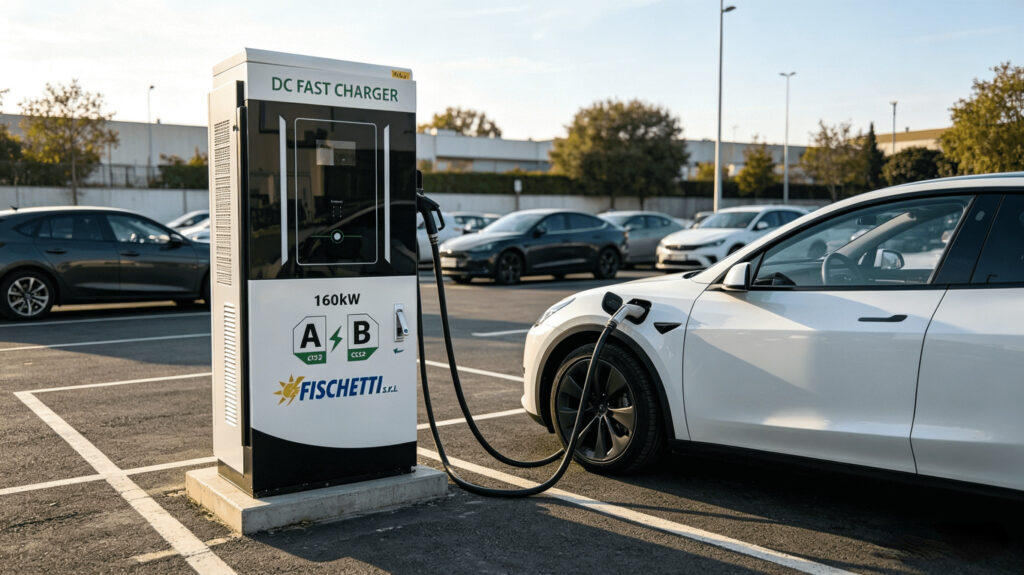
An electric vehicle charging pile turns a parking lot, highway stop, or fleet depot into a profit point. YG’s 60KW, 80KW, and 120KW DC models reach 94.5% efficiency, run from -50℃ to +50℃, and carry an IP54 rating for outdoor use. A 7-inch touchscreen and three payment methods let drivers pay in seconds. Each unit takes an EV from 20% to 80% in 30 to 40 minutes. YG Machinery supplies these chargers to operators in Russia and Mexico. This guide covers the features, specs, best sites, and the steps to choose the right model.

Start Your Project with the Right Equipment
7 Features That Make an Electric Vehicle Charging Pile Worth Buying
Seven features separate a reliable commercial charger from a basic one:
- Ultra-fast DC output. High-power DC charging cuts waiting time and suits busy public stations.
- Multi-level safety. Over-current, over-voltage, leakage, over-temperature, and lightning protection cut power automatically when something goes wrong.
- Wide temperature range. The charger works from -50℃ to +50℃ without performance loss.
- Remote management. A cloud connection lets you monitor status, start or stop sessions, and diagnose faults.
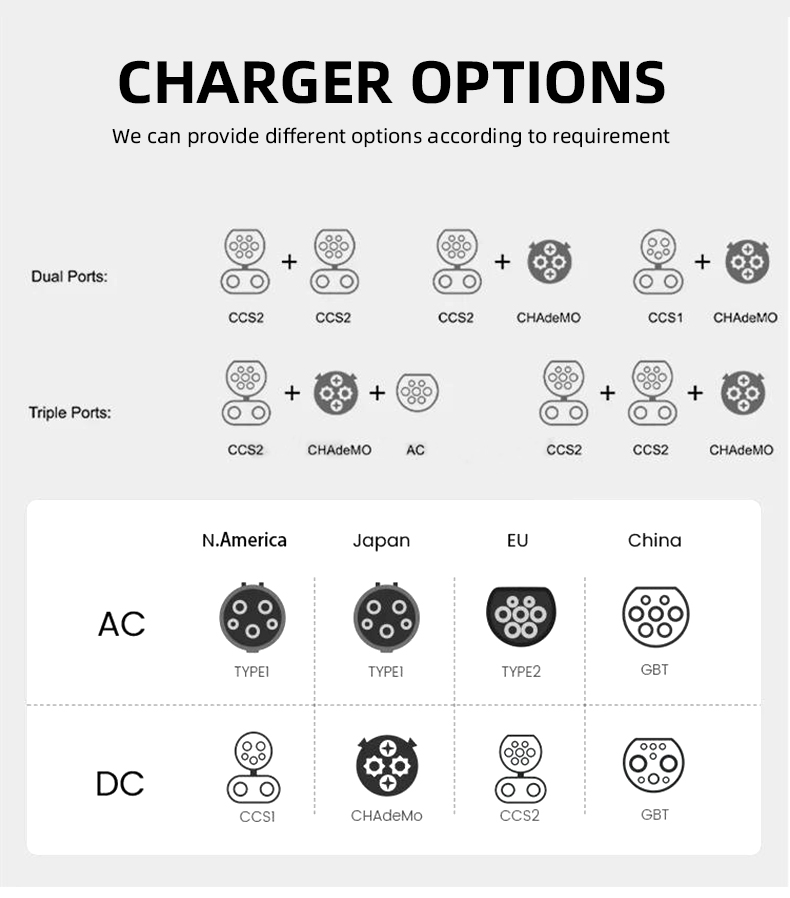
- Broad compatibility. Standard CCS and mainstream interfaces fit most electric cars, buses, and trucks in European, American, and Latin American markets, with no extra adapters.
- Built-in metering and billing. Card, QR code, and app payments simplify revenue collection.
- Sealed outdoor cabinet. The IP54 rating blocks rain, dust, and snow, making it suitable for long-term roadside installation.
What Are the Specs of YG 60KW, 80KW, and 120KW Chargers?
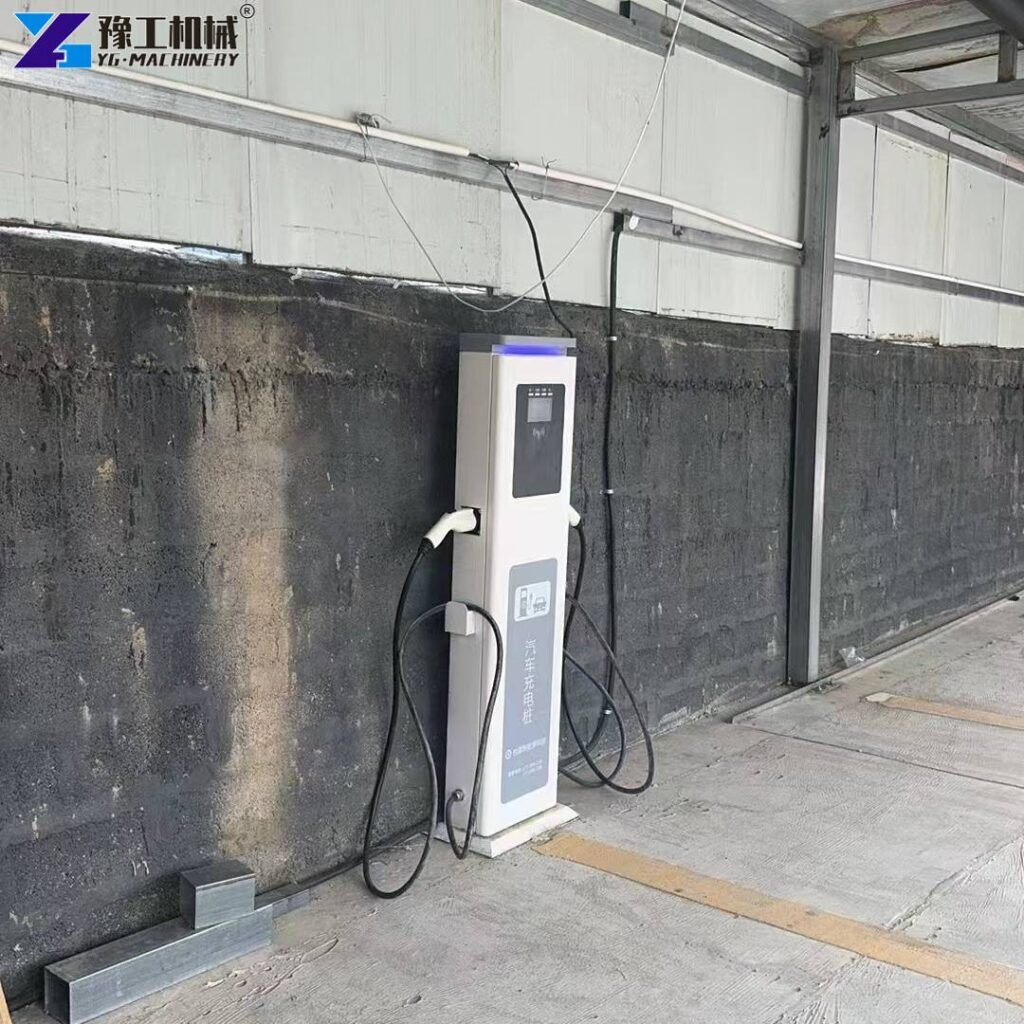
Every EV charging pile in the YG range shares one 635 x 423 x 1600 mm cabinet. Only the rated power changes. Start with the line-up, then check the full parameters.
Model overview
| Model | Rated power | Cabinet size | Reference project |
|---|---|---|---|
| YG-60KW | 60KW | 635 x 423 x 1600 mm | Mexico commercial property |
| YG-80KW | 80KW | 635 x 423 x 1600 mm | Mexico commercial property |
| YG-120KW | 120KW | 635 x 423 x 1600 mm | Russia public charging operator |
Full technical parameters (all three models)
| Category | Parameter | Specification |
|---|---|---|
| Structure | Installation | Floor-standing, down-in down-out routing |
| Cable length | 5 m | |
| Cooling method | Forced air cooling | |
| Noise | ≤60dB | |
| Input | Input voltage | AC380V ±20% |
| Input frequency | 45–65Hz | |
| Output | Output voltage | 200–750V DC |
| Current limit protection | ≥110% | |
| Electrical performance | Efficiency | ≥94.5% |
| Power factor | ≥0.99 (50% load or more) | |
| Harmonic content (THD) | ≤5% (50% load or more) | |
| Voltage regulation accuracy | ≤±0.5% | |
| Steady flow accuracy | ≤±1% | |
| Ripple coefficient | ≤±0.5% | |
| Measurement accuracy | Level 0.5 | |
| Smart features | User interface | 7-inch LCD color touchscreen, LED indicator |
| Charging modes | Auto full / fixed power / fixed amount / fixed time | |
| Payment methods | Credit card / APP/scan code | |
| Communication | Ethernet, 2/3/4G (optional) | |
| Standards | Executive standards | GB/T 20234, GB/T 18487, GB/T 27930, NB/T 33008 |
| Environment | Operating temperature | -25℃ to +50℃ |
| Working humidity | 5%–95%, non-condensing | |
| Working altitude | Below 3000 m | |
| Protection level | IP54 | |
| Reliability | MTBF | 100,000 hours |
Compare Models and Get a Quote
Built-in protection functions (13): charge gun temperature detection, overvoltage, undervoltage, overload, short circuit, grounding, overtemperature, low temperature, insulation monitoring, reverse polarity connection, lightning, emergency stop, and leakage protection.
Send us your site voltage and connector standard, and we will confirm the matching model within 8 hours.

How Do You Build an EV Charging Business With Fast DC Chargers?
Start with a busy site, the right power level, and easy payment. A successful EV charging business lives on fast turnover, because a 30- to 40-minute session frees the bay for the next driver. Follow four steps:
- Pick a high-traffic site. Highway areas, malls, and fleet depots bring repeat customers.
- Match power to demand. Choose 60KW for moderate traffic and 120KW for busy sites.
- Offer every payment option. Card, app, and QR code payments remove friction at the screen.
- Manage remotely. Track sessions and faults from the cloud to keep maintenance costs down.
Read our guide on how to make money with rapid charging stations before you plan your budget. You can also check EV charger price factors or review our rapid electric car charger project delivered to Italy.
Where Should You Install an EV Charging Station? 7 Proven Sites
Install where cars already stop for 30 minutes or more. An EV charging station performs best at these seven sites:
- Highway service areas and gas stations. Drivers on long trips need a quick top-up.
- Urban public parking lots. Mix AC and DC units to balance speed and cost.
- Shopping malls and commercial complexes. Shoppers charge while they spend, and you add a new profit point.
- Residential communities. Wall-mounted and vertical units solve daily charging for residents.
- Fleet and logistics stations. Taxis and delivery vehicles keep running with fast turnaround.
- Industrial parks. Charge employee cars and factory transport vehicles on site.
- Tourist attractions. Visitors charge while they explore.
Not sure whether you need AC or DC? Our guide to choosing the AC or DC EV charger explains the difference in plain terms.
Boost Productivity—Get a Free Quote
Why Choose a Smart EV Charger With Remote Control?
A smart EV charger saves you site visits and protects revenue. Cloud connection shows real-time status and charging data. You can start, stop, and diagnose a unit from your desk. Optional 2/3/4G communication keeps remote sites online. Drivers get four charging modes: auto full, fixed power, fixed amount, and fixed time. The 7-inch touchscreen and LED indicator make each step clear. Measurement accuracy at Level 0.5 supports fair billing. Fewer on-site checks mean lower maintenance costs, and faster fault diagnosis means less downtime.

Does It Work in Any Climate? 3 Cases From Russia, Mexico, and the USA
Yes, within -50℃ to +50℃ and 5%–95% non-condensing humidity. Three sites on three continents show how.
Case 1: Russian public charging operator (cold climate)
- Background: The client builds urban and highway charging infrastructure and needs stable outdoor equipment.
- Challenge: Deep winter stopped ordinary chargers from starting, and many DC units lacked full safety protection.
- Solution: A batch of YG-120KW units with -25℃ operation, IP54 protection, and forced air cooling.
- Result: The chargers run through winter with no startup failures. The 0.99 power factor helps reduce power consumption.
Case 2: Mexican commercial property developer (heat and humidity)
- Background: The developer adds charging to malls, parking lots, and residential communities.
- Challenge: Heat and humidity overheated earlier equipment, and a single payment mode limited users.
- Solution: YG-60KW and YG-80KW units with 5%–95% humidity tolerance, forced air cooling, and card, app, and QR code payments.
- Result: The equipment stays stable in hot, humid conditions, and drivers pay in the way they prefer.
Case 3: Highway travel plaza in Texas, USA (illustrative scenario)
- Background: A family-owned travel plaza on an interstate corridor wants to add EV charging next to its fuel pumps, store, and diner.
- Challenge: Drivers will not wait an hour on a road trip, so the site needs fast turnover. Summer heat exceeds 40℃, so the equipment must run all day outdoors. The plaza also has 480V three-phase power, while the charger takes AC380V ±20% (about 304–456V).
- Solution: Four YG-120KW units stand in the front row of the lot. A step-down transformer converts the 480V supply to 380V. Each charger uses the standard CCS connector, and the owner checks local certification requirements before ordering. Card, app, and QR code payments cover every driver, and the cloud platform shows all four units from the store counter.
- Result: Drivers charge from 20% to 80% in 30 to 40 minutes, which fits a meal or a rest stop. The 94.5% efficiency limits energy loss in hot months, and the owner checks faults from the cloud instead of walking the lot.
- Takeaway: Match the charger to the grid first, then match the payment options to your customers.
Each case follows the same logic: find the site’s real constraint, match the model to it, then confirm the result on site.
Find the Right Model for Your Project

5 Steps to Choose Your Charger and 3 Ways to Start Today
Choose the charger in five steps:
- Match type to scenario. Use DC for public and fast-charging sites. Use AC for private parking to save costs.
- Verify safety functions. Confirm short-circuit, leakage, and over-temperature protection.
- Check smart features. Prioritize multiple payment methods and optional 2/3/4G communication.
- Confirm power and interface. Check local EV models, connectors, and your grid supply. Ask us for compliance documents that match your country’s rules.
- Verify after-sales support. YG provides installation guidance, operator training, long-term spare parts, and 24-hour remote technical support.
Then pick the path that fits your stage:
- Still learning? Read our guide to choosing AC or DC chargers and compare our commercial EV charging stations.
- Comparing models? Send your site type, target power, and local connector standard. We reply within 8 hours.
- Ready to buy? Request a free quote on WhatsApp at +86183 3715 2861, or email admin@ygequip.com. Ask about discounts on batch orders.
The right electric vehicle charging pile pays back through steady sessions, low downtime, and happy drivers. Send your inquiry today and start building your network.